Your decision owner
Sets the boundary, gives context, names stakeholders and confirms the intended outcome. Approval follows the configured roles.

Implementation approach
Start with a bounded product question or operational workflow. Agree the evidence, review points and responsibilities before expanding the work. A Product evaluation can begin independently, without a process assessment or connected repository.

A practical sequence
Use the stages as a discussion framework. Timing, deliverables and responsibilities depend on the agreed scope; this is not a fixed delivery commitment.
Agree the product or process boundary, participants, intended outcome and what is outside the first project.

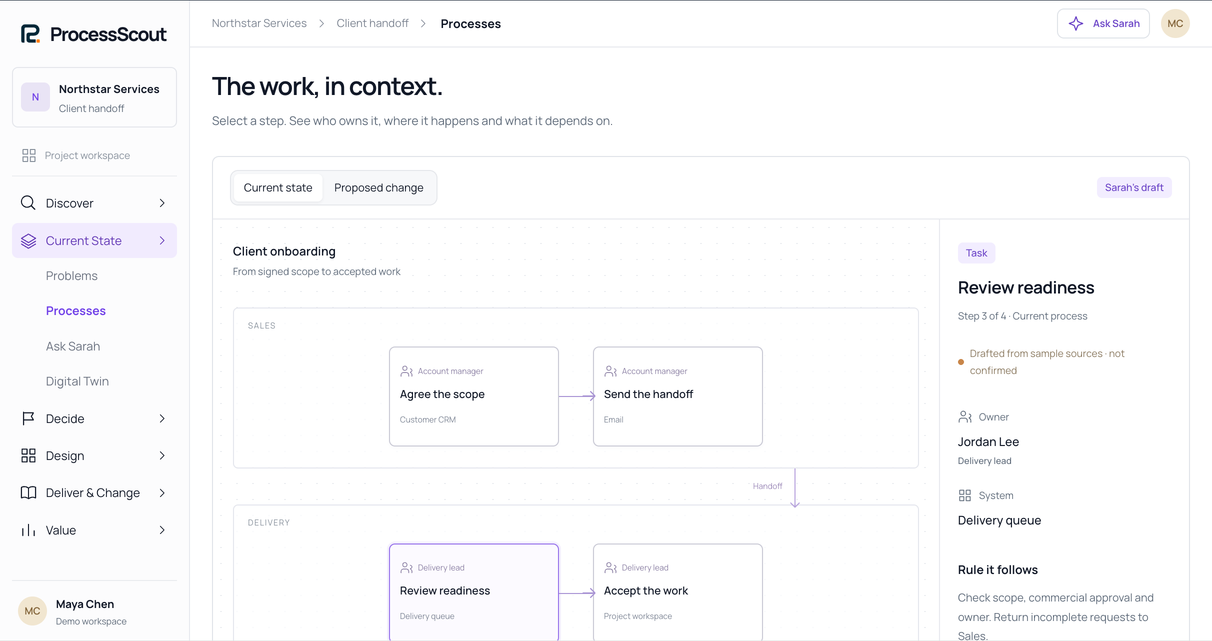
Gather representative evidence. For Product, inspect requests, customer context and direction. For process work, review the current flow, workbook logic and exceptions.

Compare practical options, priorities, effort, risks and dependencies. Record why a direction was chosen. Keep capacity value separate from cash savings.

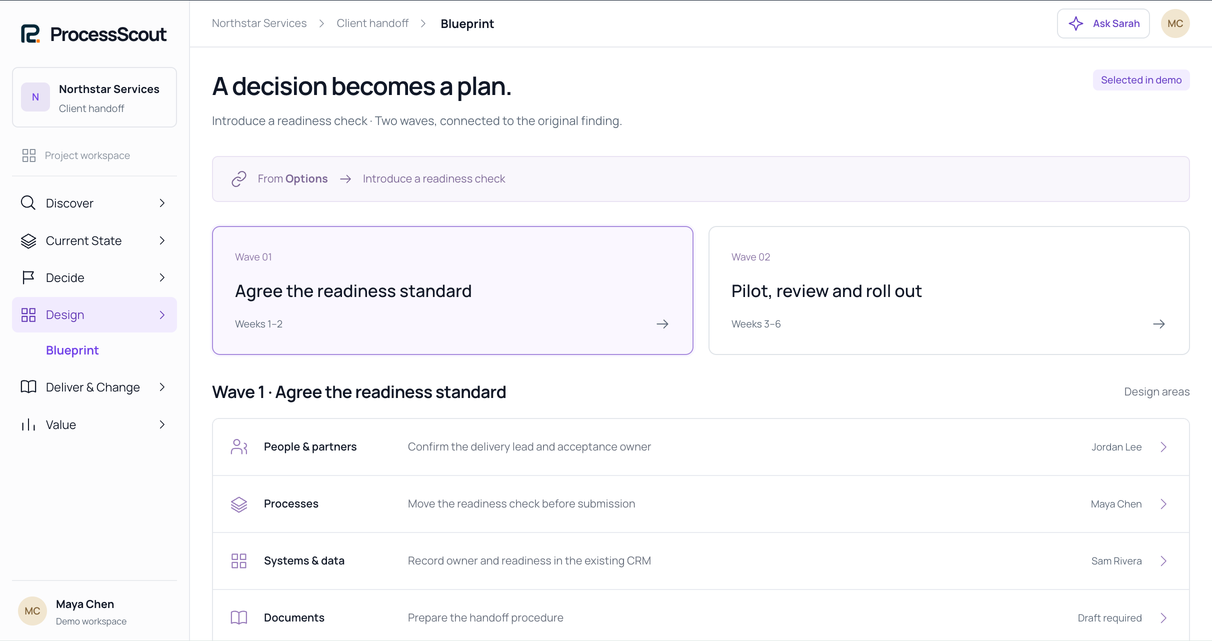
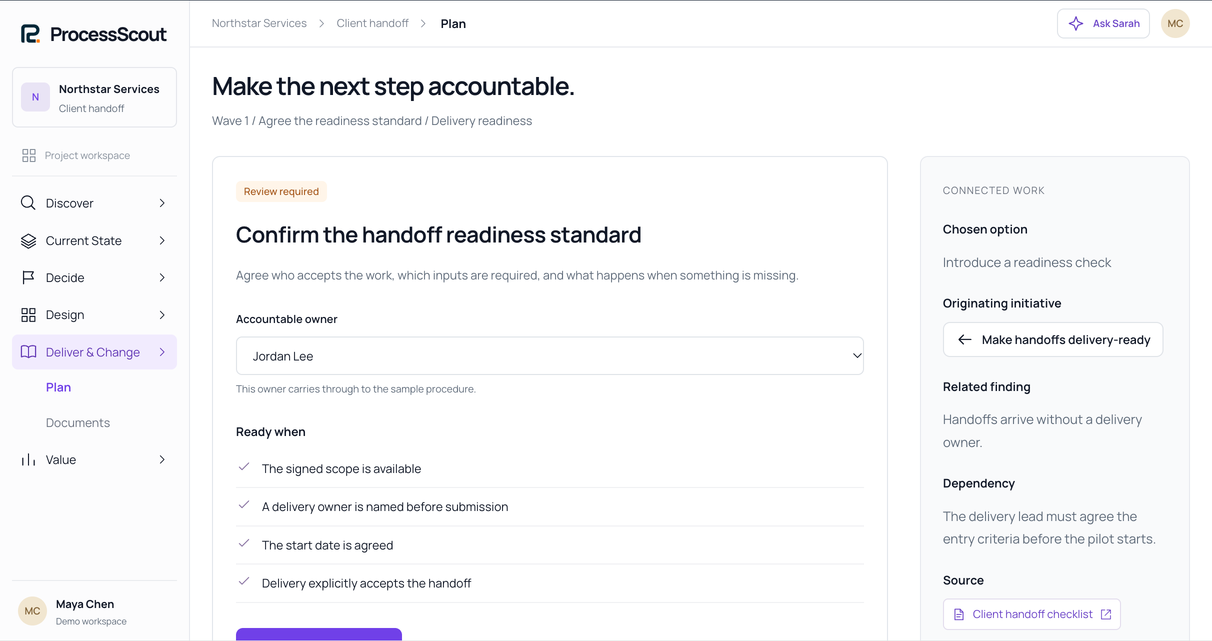
Define requirements, artifacts, owners and acceptance criteria for the chosen route. Where Build Factory fits, confirm setup, scope, checks and approvals first.
Review adoption, exceptions and the agreed measures. Separate a completed release from evidence that a business outcome improved.

Real product screens · fictional Northstar data
Work together
The platform can organize evidence and help produce reviewable work. Context, acceptance and adoption still need the people who understand the product, its customers or the operation.
Sets the boundary, gives context, names stakeholders and confirms the intended outcome. Approval follows the configured roles.
Check findings, assumptions, proposed changes and the evidence used to accept an output.
Confirms source access, integrations, privacy requirements and any implementation environment.
Prepares the work, raises questions and completes the scoped deliverables. Our involvement is agreed separately.
Choose an entry point
A Product session can begin with a goal, representative requests and an intended measure. A process project can begin with a workbook, a recurring workflow or a specific change.

Understand its inputs, calculations, rules and risks before deciding what to change.

Connect the evidence, handoffs and systems around a recurring problem.

See how a prepared brief becomes a reviewed build, ready for your team to deploy. Beta.
Real product screens · fictional data
Prepare the project
The preparation checklist turns the approach into a practical starting brief your team can agree before anyone schedules work.

Plan the first project
Tell us the decision you want to improve and who owns it. We’ll help frame the boundary, the evidence to gather and the review points, before any timeline is set.
Allow optional analytics to help us improve ProcessScout? Privacy notice