
16.4
business hoursSample. Fictional company.
ONE WORKFLOW. A CLEAR NEXT MOVE.
The work,
made clear.
A Trail Map from the customer order to the next decision.
Northwind Supply Co.A fictional US distributor. Example company size: 80 people.
ORDER TO INVOICEWorkflow · Evidence · Opportunities · 90-day planPUBLIC SAMPLE / 2026
An authored example, not a client engagement. All company details, records, observations and operational figures are fictional examples. Proposed effects are hypotheses to test, not achieved results. No analyst sign-off is claimed for this sample.
NINE MORE WORKED EXAMPLES
Start with work you recognize.
This page follows Northwind’s order-to-invoice trail in depth. For a focused nine-page report, choose a workflow. Every company, record and figure is fictional.
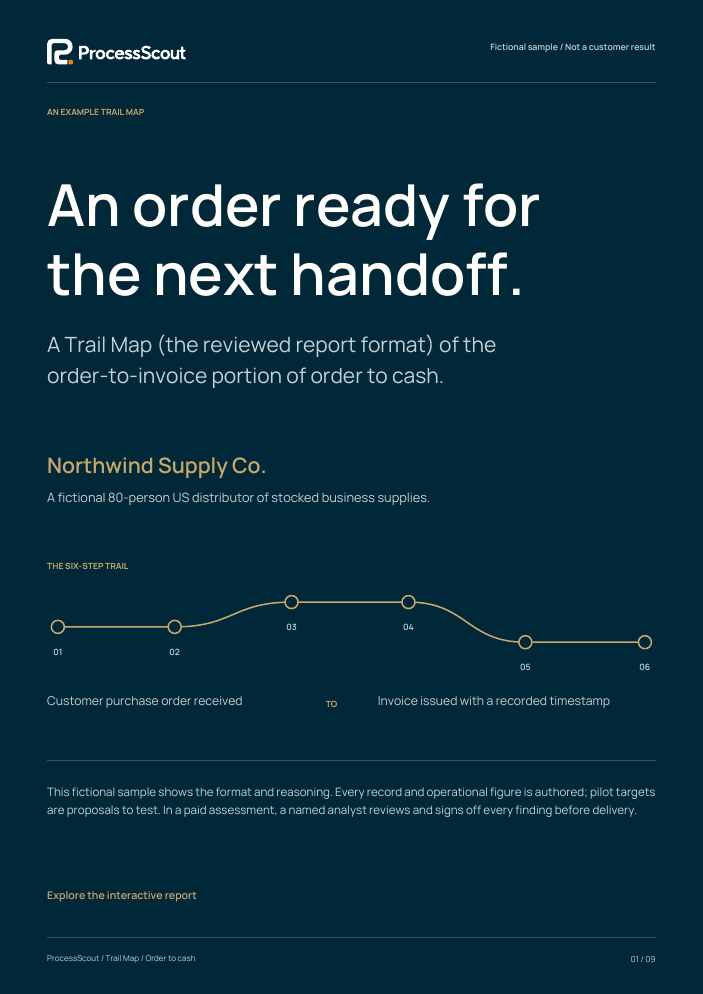 Northwind Supply Co.Order to cash ↗Order intake, dispatch evidence and the handoff to invoicing.
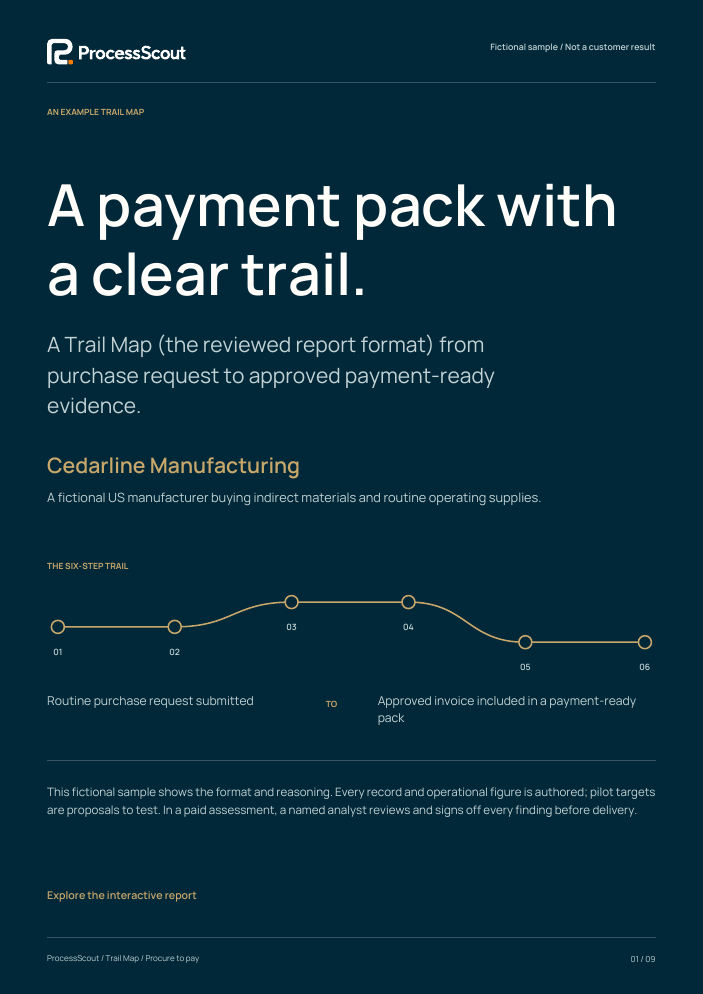 Cedarline ManufacturingProcure to pay ↗Invoice matching, receipts and approval before payment.
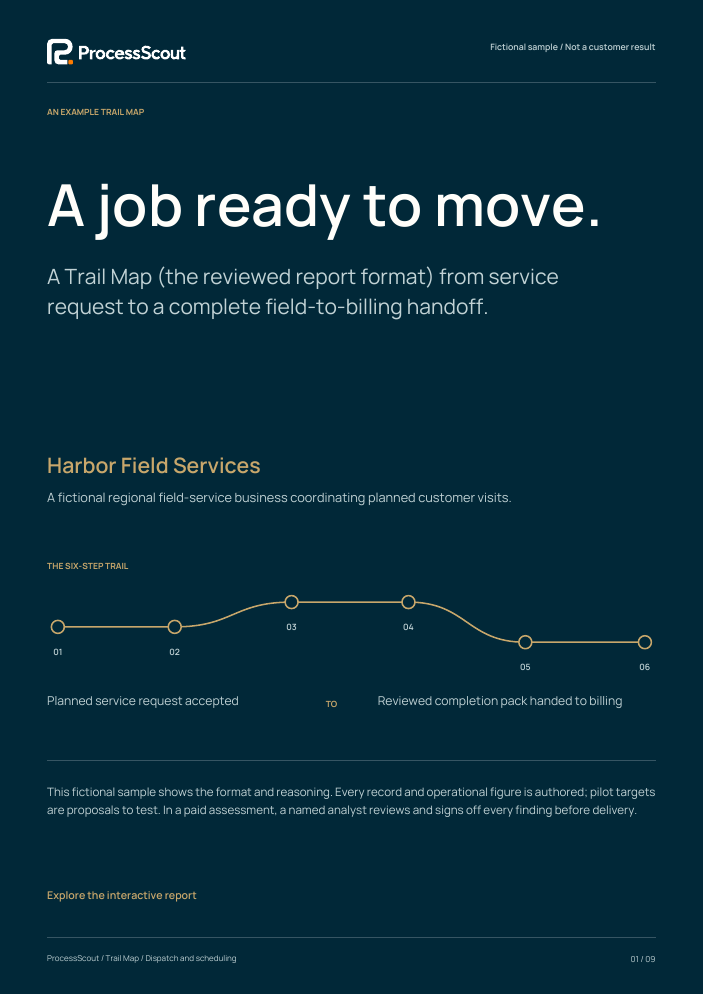 Harbor Field ServicesDispatch and scheduling ↗Job readiness, field changes and completion evidence.
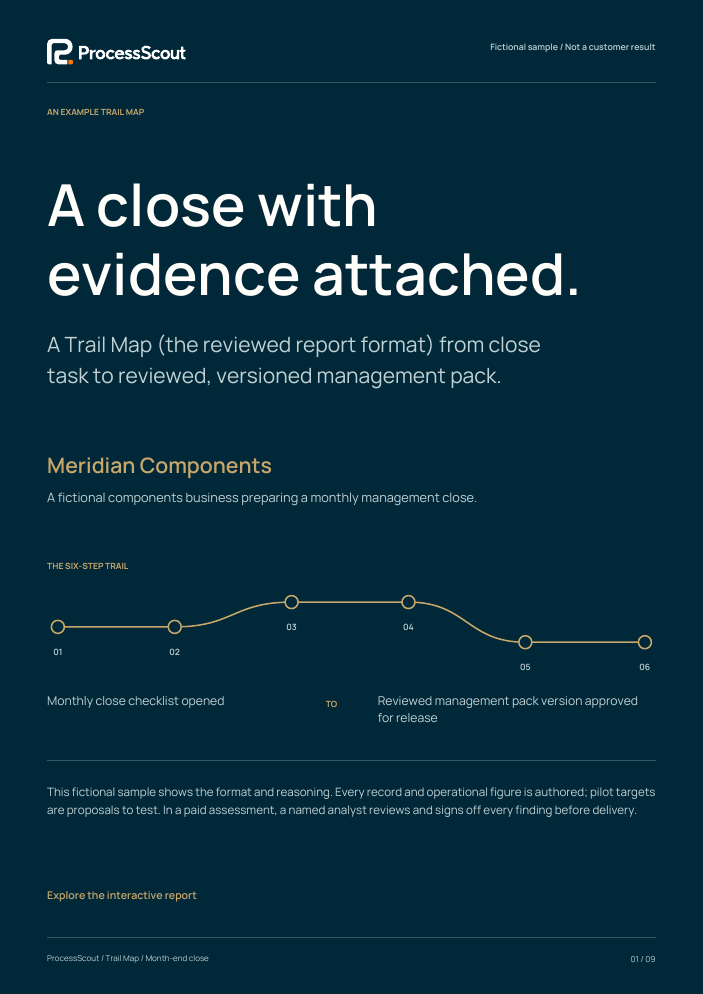 Meridian ComponentsMonth-end close ↗Reconciliation support, reviewer coverage and close decisions.
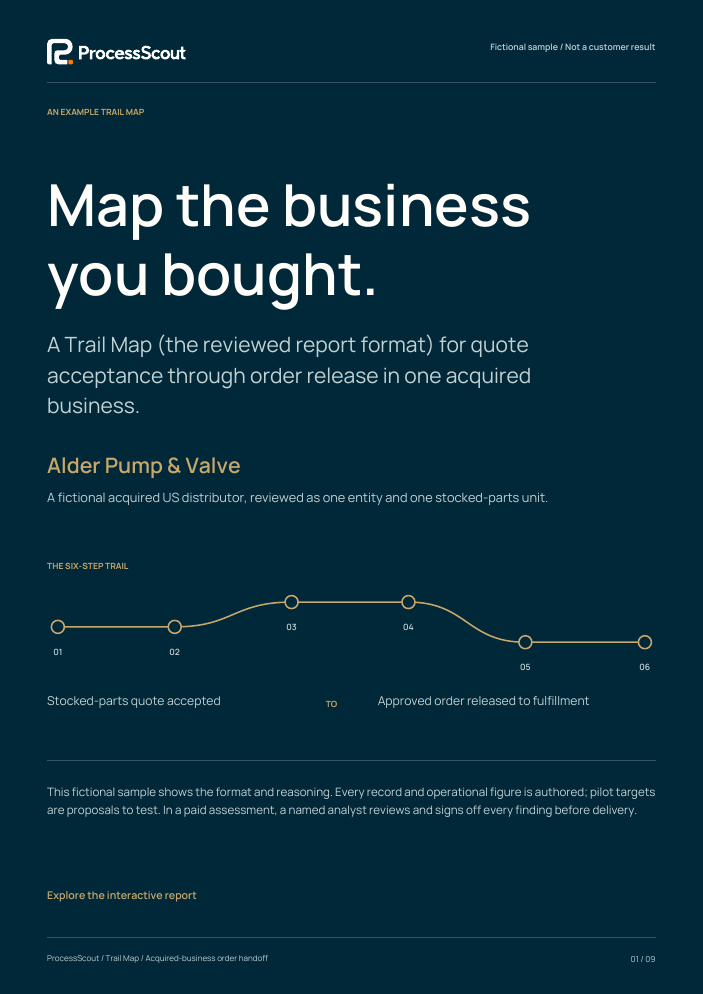 Alder Pump & ValveAcquired-business order handoff ↗Quote revisions and legacy account meaning after a deal.
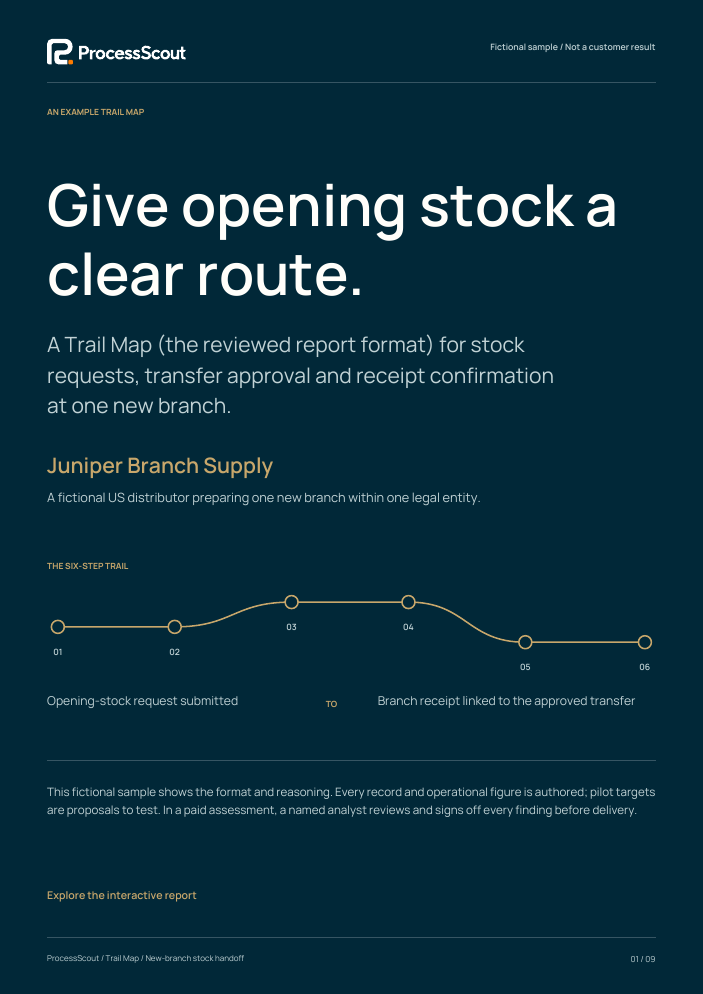 Juniper Branch SupplyNew-branch stock handoff ↗Opening stock, delegated approval and receipts at a new branch.
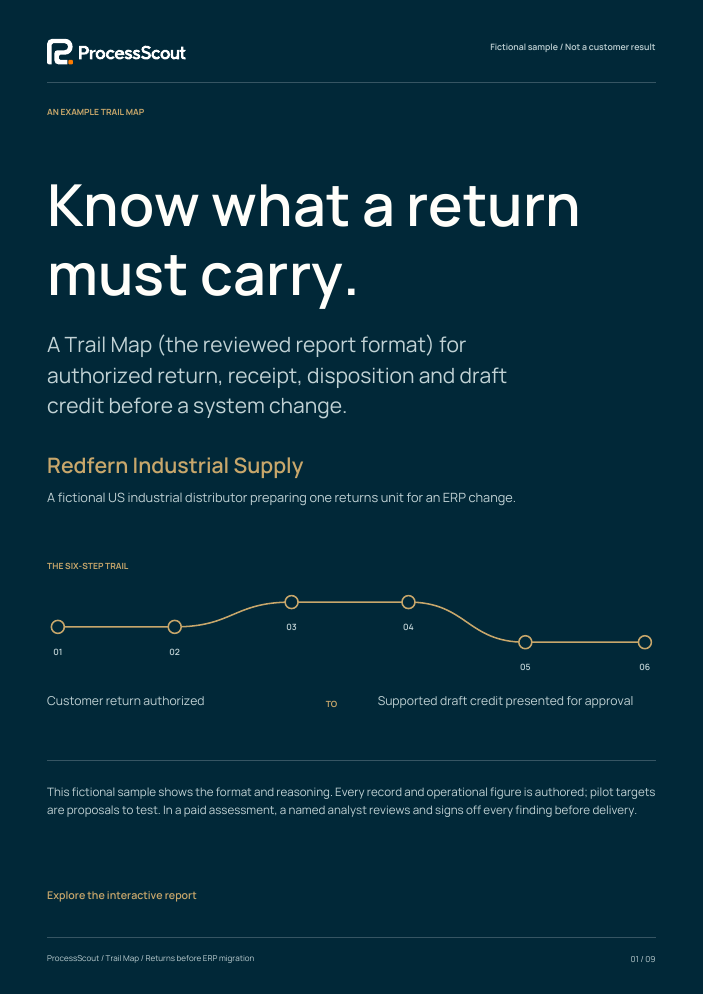 Redfern Industrial SupplyReturns before ERP migration ↗Return data, disposition and credit before an ERP change.
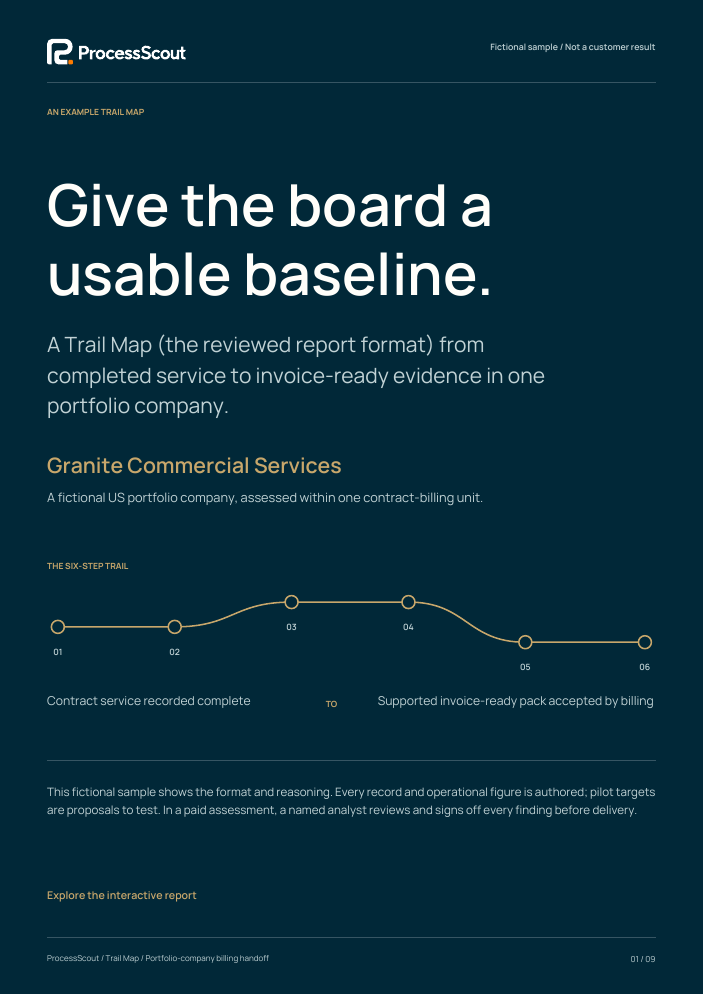 Granite Commercial ServicesPortfolio-company billing handoff ↗Customer acceptance and scope-change approval.
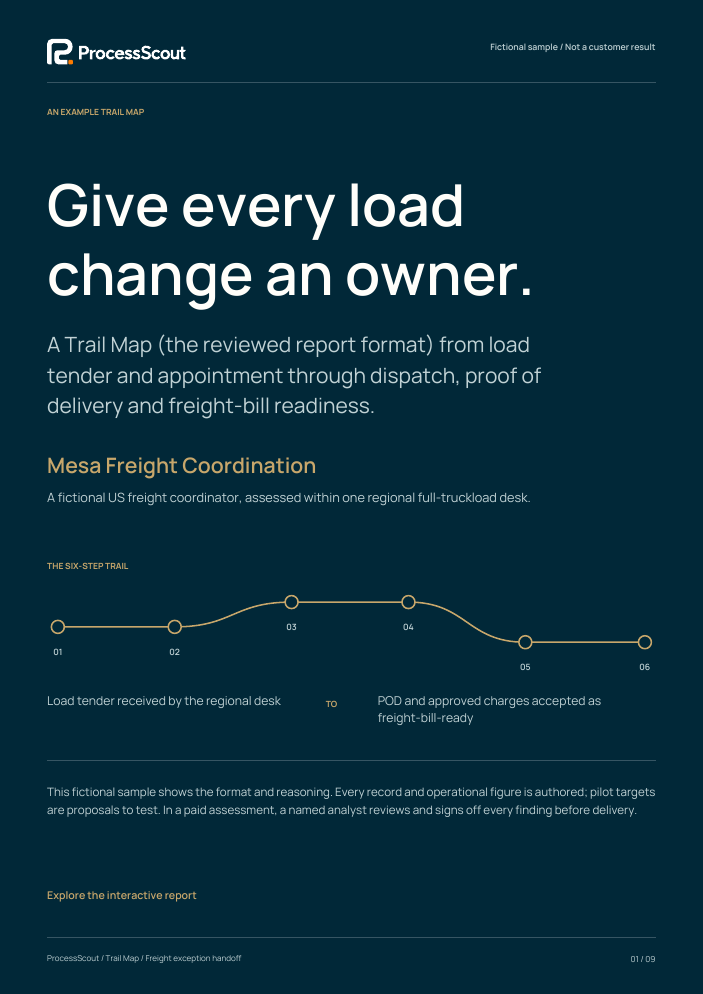 Mesa Freight CoordinationFreight exception handoff ↗Appointment changes, delivery proof and accessorials.
01 THE DECISION
Fix the handoffs. Then connect the systems.
In this example, the order travels through familiar tools. The difficulty sits between them: incomplete order details, an unclear invoice-ready handoff and repeated entry of the same information. The first move is to make the work complete and owned. Only then is a small integration worth testing.
01
Start here / Low effort
02A complete order, first time.
S01 + S02 ↗
Pilot next / Low effort
03An owned handoff to invoicing.
S04 + S05 + S06 ↗
Prove feasibility first / Medium effort
Less repetition, with control.
S02 + S06 ↗
The example evidence points to specific places to investigate. It does not establish what would happen after a change. Each recommendation therefore includes the evidence, a competing explanation and a measurement gate.
What this does not authorize
Do not approve a broad system replacement, book a financial saving or extrapolate these figures to the whole business. Cash collection, purchasing and non-stock orders are outside this review.
The workflow reviewedOne workflow: standard stocked business orders, from receipt of a customer purchase order to issuance of the invoice. This is the order-to-invoice portion of order-to-cash.+
INSIDE THE REVIEW
- One example legal entity and one distribution business unit.
- Standard stocked B2B orders with a completed invoice in the example cohort.
- Order completeness, internal release, fulfillment confirmation, invoice preparation and issuance.
- The roles, systems, handoffs, rework and manual entry within that boundary.
OUTSIDE THE REVIEW
- Cash receipt, collection activity, days sales outstanding and bad debt.
- Supplier purchasing, demand forecasting, returns and non-stock or bespoke orders.
- Credit-policy redesign, tax advice, regulatory assurance and production implementation.
- Claims about company-wide savings, headcount reduction or customer outcomes.
The example cohort. Example review window: four working weeks. The synthetic cohort contains 100 completed orders. Open, canceled and returned orders are excluded, so this sample cannot describe backlog or overall service performance.
The questions that matter. Is the order complete before it reaches release? What exactly makes a dispatched order ready to invoice? Which information is entered again, by whom and why?
The sources are constructed to make the reasoning inspectable. They are not a statistical sample, independent corroboration or evidence about an actual company. A paid assessment replaces every example with the evidence your team authorizes.
03 THE CURRENT TRAIL
The work is familiar. The gaps are between the steps.
Follow the order through its roles and systems. Open a step to see the input, the output and the source behind it. All roles, systems and times below are examples.
S01↗Receive the order
Customer service
Shared order mailboxExample mean 0.5hInspect this step +
S02↗Validate and enter
Customer service
ERP order screen + price sheetExample mean 2hInspect this step +
S03↗Approve release
Credit controller
ERP credit queueExample mean 1hInspect this step +
S04↗Pick and dispatch
Warehouse team
Warehouse systemExample mean 8hInspect this step +
S05↗Match the dispatch
Accounts receivable
Dispatch spreadsheet + ERPExample mean 3.4hInspect this step +
S06↗Prepare and issue
Accounts receivable
ERP invoice screenExample mean 1.5hInspect this step +
The order moves through the sequenceExample: three planned role handoffsCash collection is outside scope
Stage intervals include both work and waiting. They sum to the mean elapsed business-clock time; they are not labor-time estimates. The records use an example eight-hour working day.
04 THE BASELINE
A number is useful when you can trace it.
These are starting measures for the fictional workflow. Every operational number below is an example. The source, denominator and limits are part of the measure.
25%
of example ordersOrders needing clarification
Definition & calculation6.5
manual touches / orderHands-on interventions
Definition & calculation12
minutes / walkthroughOrder and invoice entry
Definition & calculationWHERE THE EXAMPLE TIME SITS
Mean stage intervals
Example business hours / order. Source E01. Fulfillment time is in scope for measurement; it is not a target of these recommendations.
M01 / Mean order-to-invoice time
Sum of elapsed business-clock hours across the completed order cohort, divided by completed orders. Stage times include both work and waiting; they are not labor hours.
Example calculation1,640 business hours / 100 orders = 16.4 business hours per order.
An example eight-hour working day is used to construct the durations. No calendar-time or on-time-delivery claim follows.
E01M02 / Orders needing clarification
Orders with at least one missing required field that triggers a clarification loop. An order is counted once even if several fields are missing.
Example calculation25 affected orders / 100 orders = 25%.
This measures order-completeness rework only. It is not the total error rate across the business.
E02M03 / Hands-on interventions
One deliberate human intervention at each of the six steps, plus two extra interventions on each order needing clarification. A touch is not a person or a handoff.
Example calculation(100 orders x 6 touches + 25 orders x 2 extra touches) / 100 = 6.5.
The example has three planned role handoffs: customer service to credit, credit to warehouse, and warehouse to accounts receivable.
E01M04 / Order and invoice entry
Mean manual entry time at S02 plus S06 in five authored walkthroughs. The mean is eight minutes at order entry and four at invoice entry. Existing approval activity is separate.
Example calculation(12 + 12 + 12 + 12 + 12) minutes / 5 walkthroughs = 12 minutes.
A deliberately small example. Validate task timing, exception coverage and field-level necessity before using it to size a change.
E0305 FOLLOW THE EVIDENCE
Follow one order through the evidence.
Example order NW-028 needs a ship-to clarification at S02. Its dispatch later reaches S05 without a named match owner. The two exceptions occur on the same order; this does not prove that one causes the other.
The question to test
Would the delay remain if the order arrived complete and the invoice-ready exception had an owner? The sample cannot answer that. The pilot can test it.
FICTIONAL EXAMPLE / NW-028Example total: 22 business hours · 8 manual touches
- S01Receive the order0.5h exampleRecorded stage interval
- S02Validate and enter5h exampleShip-to clarification
- S03Approve release1h exampleRecorded stage interval
- S04Pick and dispatch8h exampleRecorded stage interval
- S05Match the dispatch6h exampleMatch owner missing
- S06Prepare and issue1.5h exampleRecorded stage interval
06 THREE EVIDENCE-BACKED OPPORTUNITIES
A recommendation should survive a closer look.
Each opportunity connects a proposed change to a specific step, source, effect model and decision gate. Effects are examples, not promises.
07 THE ORDER OF CHANGE
Completeness→Ownership→Controlled reuse
Sequence the decisions, not just the tasks.Completeness defines what can move. Ownership defines who moves it. Only then does a field mapping have a stable destination. This ordering is a recommendation for the fictional workflow, not a universal implementation formula.+
- Treat the three effects separately. The same order can appear in more than one opportunity, and task-capacity estimates can overlap.
- Keep elapsed time, labor time and cash separate. None of the example calculations establishes a realized financial return.
- A failed pilot is useful evidence. Keep the baseline, record the finding and revise or stop the change before expanding it.
01
Start here Low effort
Make the order complete at the start.
Proposed owner: Customer service lead Steps S01 + S02
What changes
Introduce a short intake checklist for the purchase-order reference, account, ship-to, item, quantity and agreed price. Give incomplete orders an explicit status and a named resolver before release. Keep the original request attached.
EXAMPLE EFFECT / TO TEST
Example pilot target: reduce clarification from 25% to 10% of eligible orders. That is a 15-percentage-point reduction, or 15 fewer clarification loops per 100 comparable orders. It is a test target, not a forecast.
Inspect the calculation
100 comparable orders x (25% - 10%) = 15 fewer affected orders. Do not turn this into a cash saving without timing and financial evidence.
02
Pilot next Low effort
Give every invoice-ready exception an owner.
Proposed owner: Accounts receivable lead Steps S04 + S05 + S06
What changes
Create one invoice-ready queue with order ID, dispatch reference, readiness status, exception reason, owner and next review time. Route unmatched items to a named resolver. Keep invoice issuance subject to the existing checks.
EXAMPLE EFFECT / TO TEST
Example scenario: if the 35 qualifying records move from six to two business hours at S05, mean order-to-invoice time falls by 1.4 business hours per order. This is elapsed-time reduction, not labor capacity or earlier cash collection.
Inspect the calculation
35 records x (6 - 2) business hours / 100 orders = 1.4 business hours less per order. The example mean would move from 16.4 to 15.0 business hours if every other stage stayed unchanged.
03
Prove feasibility first Medium effort
Carry approved information forward.
Proposed owner: ERP owner + finance lead Steps S02 + S06
What changes
Test a small, supported field mapping from the approved order to a draft invoice. Show discrepancies for review, retain the original values and require a person to approve issuance. Start with a dry run and a reversible mapping.
EXAMPLE EFFECT / TO TEST
Example scenario: keep mean order entry at eight minutes and reduce invoice entry from four to one minute. Total entry time would move from twelve to nine minutes. Across 100 comparable orders, that would release five hours of task capacity. No cash saving, staffing reduction or payback is claimed.
Inspect the calculation
100 orders x (12 - 9) minutes / 60 = 5 hours. Assumes S02 remains at eight minutes, S06 moves from four to one, existing review effort stays unchanged and every eligible order uses the mapping. Excludes exceptions, setup, support and adoption time. Do not add this to the other opportunities.
08 THE 90-DAY PLAN
Make the next move small enough to learn from.
A sequenced example plan. Each phase ends with evidence and a decision, not an automatic instruction to expand the change.
- Weeks 1-4
Establish the facts. Stabilize intake.
Process owner + customer service lead
Agree the boundary, replace the synthetic baseline with actual authorized evidence and pilot the completeness checklist.
DECISION GATEExample gate: the O01 pilot meets the clarification target, all overrides have an owner, and the process owner accepts the impact on entry effort.
- Weeks 5-8
Make the handoff dependable.
Accounts receivable lead + warehouse lead
Pilot the invoice-ready queue and check integration feasibility without altering credit or invoice approval.
DECISION GATEExample gate: eligible S05 items meet the queue-time target without more invoice corrections; the mapping has an agreed validation and fallback design.
- Weeks 9-12
Prove the mapping. Decide what scales.
ERP owner + finance lead + process owner
If the earlier gates pass, run a limited draft-invoice pilot. Reconcile the results before expanding use.
DECISION GATEExample gate: all pilot drafts reconcile, repeated-entry effort meets the target, and the finance lead accepts the controls. Otherwise pause or return to the manual fallback.
DAY 90
Days 85-90: close the review. Confirm what changed, what the evidence supports, who owns the process and what remains unresolved. Record any financial benefit only if finance has validated it. No benefit is assumed in advance.
09 MEASUREMENT & OWNERSHIP
Make the result reviewable.
The baseline is a starting point, not a promise. Use the same definitions and comparable cohorts before and after each change. Record changes in demand, staffing, order mix and exceptions alongside the numbers.
| Measure | Baseline | Test target | Proposed owner | Review point |
|---|---|---|---|---|
| M02Clarification rate | Example: 25% of 100 orders | Example: no more than 10% of 50 pilot orders | Customer service lead | End of week 4; then weekly during the pilot |
| M05S05 elapsed time, eligible subgroup | Example: 6 business hours; 35 records | Example: 2 business hours in a comparable subgroup | Accounts receivable lead | End of week 8; daily queue checks |
| M04Order and invoice entry time | Example: 12 minutes; 5 walkthroughs | Example: 9 minutes in total; 50 eligible pilot orders | ERP owner + finance lead | End of week 12; review each pilot batch |
| M01End-to-end cycle | Example: mean 16.4 business hours; 100 orders | Diagnostic measure; do not set an aggregate benefit target yet | Process owner | Each phase gate and the day-90 review |
Sources, guardrails and keeping the comparison honest.Where each measure comes from, what must not get worse, and four rules for reading a before-and-after result.+
- Clarification rate. Source: E02; intake checklist and clarification log. Guardrail: Record intake effort and every authorized override.
- S05 elapsed time, eligible subgroup. Source: E04; dispatch and invoice-ready timestamps. Guardrail: Track invoice corrections and unresolved queue items.
- Order and invoice entry time. Source: E03; task timing and draft reconciliation. Guardrail: No unexplained field mismatch or duplicate draft; approval remains mandatory. Check that the unchanged S02 entry time and review effort assumptions hold.
- End-to-end cycle. Source: E01; the same start and finish events. Guardrail: Report cohort mix, open items and exclusions separately.
- Freeze the event definitions before the pilot. Keep order identifiers so a reviewer can reconcile records across sources.
- State the denominator, observation window and exclusions on every comparison. Inspect the distribution and exceptions, not just the mean.
- Keep a decision log: what changed, when, who approved it and what else changed at the same time.
- Treat before-and-after movement as an observed association. Use a more controlled comparison if a causal claim matters to the investment decision.
10 THE STARTER ASSET
A starter asset your team could use tomorrow.
Example working template. Review with the process owner before use.
THE RECORD TO KEEP
Order ID and original purchase-order reference
Customer account, ship-to and named contact
Item, quantity and approved price reference
Completeness status: ready / waiting / approved exception
Dispatch reference and confirmation timestamp
Invoice-ready status, exception reason, owner and next review
Credit approval reference, invoice reviewer and issue timestamp
12 THE SOURCE REGISTER
Take the evidence with you.
Every source below is authored fiction. The downloadable records reproduce the example arithmetic and link by order ID. They are not customer data, interview evidence or independent corroboration.
E01Order trail register
+
Example: 100 completed orders, with stage business-clock durations, clarification status and touch counts. The common order ID connects the supporting records.
- Supports
- Workflow stages; mean cycle; touch count; the NW-028 trace.
- Limit
- Authored synthetic durations, not system event logs. No distributional or company-wide inference.
E02Order completeness audit
+
Example: the same 100 orders; 25 have a missing required field and a clarification loop. Each affected record names the field.
- Supports
- O01 and the clarification baseline.
- Limit
- Constructed field flags, not independent evidence or a causal test.
E03Entry walkthrough notes
+
Example: five authored walkthroughs showing order and invoice entry time and repeated fields. Mean combined entry time is twelve minutes.
- Supports
- O03 and the manual-entry baseline.
- Limit
- A small illustrative set; it cannot validate an investment case or an automation interface.
E04Invoice-ready queue
+
Example: the same 100 orders; 35 lack a named match owner. The S05 intervals match the order trail register.
- Supports
- O02, the subgroup comparison and the NW-028 trace.
- Limit
- Missing ownership and delay are associated by construction. Causality is not established.
E05Current procedure and role notes
+
An authored description of the six-step workflow, existing approval boundaries and the incomplete ownership rule.
- Supports
- Role and system mapping, scope, dependencies and proposed checklist.
- Limit
- Fictional procedure, not an interview transcript or an actual operating policy.
The complete working pack.
The PDF, synthetic records, calculation notes and blank readiness checklist.
11 THE OPEN QUESTIONS
Good work makes uncertainty visible.
Resolve these before a larger investment. The sample does not turn an untested assumption into a confident claim.
Does the cohort represent the work?
Completed, stocked orders exclude backlog, canceled items and complex exceptions.
Is ownership the cause of delay?
Batching, staffing or shipment complexity could explain the longer interval at S05.
Can the systems reuse the fields safely?
An available screen is not proof of a supported API, import or reliable identifier.
Will released time become useful capacity?
Task time is not the same as a payroll saving or a measurable service improvement.
14 YOUR TRAIL MAP
Your workflow. Your evidence. Your next move.
Bring one workflow worth understanding. Leave with evidence-linked opportunities and a practical plan for what comes next.
Start an assessmentStart with your own evidence. This sample stays freely available.
$1,500USD. Fixed price for one workflow.
- Five business days after your evidence checklist is complete.
- Reviewed by a senior process analyst.
- A 90-day plan.
- Three opportunities or your fee back.
If ProcessScout cannot identify at least three evidence-backed opportunities from a good-faith intake, the assessment fee is refunded under the assessment terms. This is a deliverable guarantee, not a promise of realized savings.

ProcessScout review lead
David Bell ↗
25 years in operations and finance, including Shell and Deutsche Bank; founder and CEO of JustPayroll through its 2024 acquisition.
David Bell leads the review approach. The analyst assigned to your assessment owns its recommendations and sign-off. This sample shows the format. In a paid assessment, a named analyst reviews and signs off every finding before delivery.
Credit toward implementation
The full $1,500 fee can be credited toward a ProcessScout-delivered implementation of $7,500 or more signed within 30 days of Trail Map delivery. Unused credit expires; it cannot be transferred to fees charged by your own implementation partner.
Cancellation and scope protection
Cancel before analyst review starts for a full refund. If the report materially misses the agreed brief, tell us within 14 days of full access and choose an in-scope correction or a refund after review.
Read the full protection policy ↗Scope and terms
This sample illustrates the form and depth of the work. The actual findings depend on your evidence and agreed scope. Production implementation is a separate engagement. CSV-only financial evidence requires preapproval and a separately agreed delivery date.
Read the assessment terms ↗How a paid Trail Map is madeYour team brings the context. We make the work reviewable. The fictional sample illustrates the deliverable; it is not a completed engagement or a signed analyst report.+
- 01
Define one workflow
Agree a start, a finish, the business boundary and the decision the assessment should support. Resolve scope questions before gathering evidence.
- 02
Complete the guided assessment
Walk through normal work and exceptions, supply the authorized source material and answer blocking questions. The delivery clock starts when the evidence checklist is complete.
- 03
Trace evidence into recommendations
Connect each finding to a source and a workflow step. Separate observations, assumptions and proposed effects. Make missing evidence visible.
- 04
Senior process analyst review
A senior process analyst reviews evidence sufficiency, assumptions, priorities and measurement design before the paid Trail Map is delivered.
- 05
Deliver the decision and the plan
Receive the reviewed Trail Map and a 90-day plan in five business days after the evidence checklist is complete. The exact workflow and scope are agreed during intake.