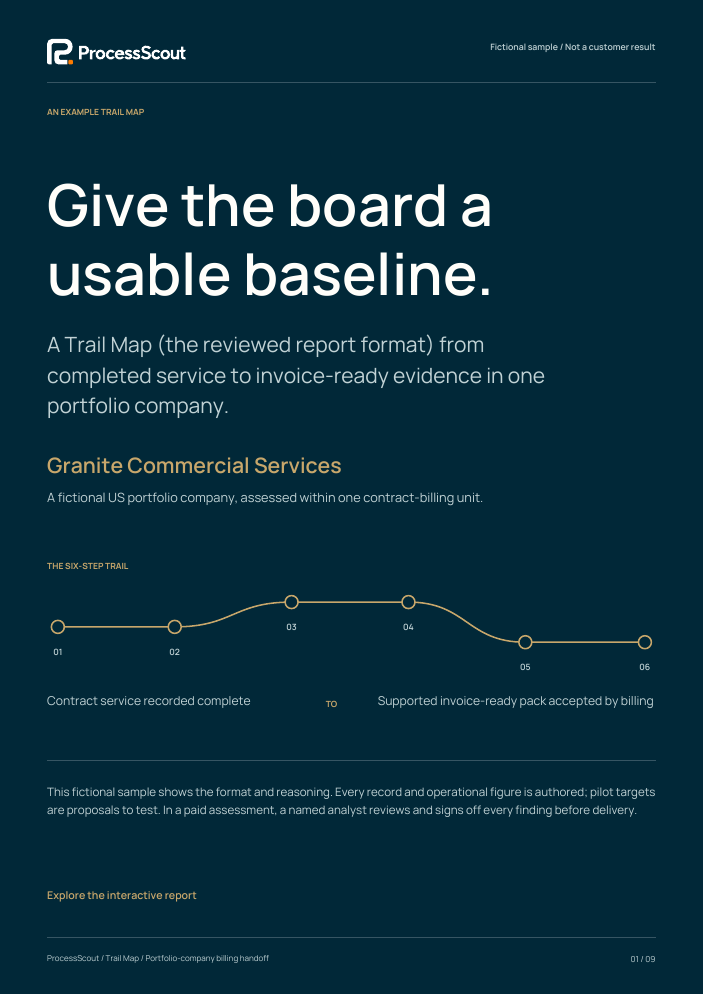
Take one portfolio company’s recurring workflow from a value hypothesis to a reviewed operating plan. Give its management team a baseline, named owners and a clear pilot decision.
Completed service is waiting for customer acceptance
Extra work reaches billing without a signed change
The value plan has a target, but no operating baseline
Real product, demo data. Granite Commercial Services is a fictional example.
David BellProcessScout review lead
David brings 25 years of experience in operations and global finance, including Shell and Deutsche Bank. He was founder and CEO of JustPayroll through its 2024 acquisition.
David Bell leads the review approach. The analyst assigned to your assessment owns its recommendations and sign-off. Every paid Trail Map receives human review before delivery.
Confirm the question and scope. Bring authorized source records, a complete walkthrough, supporting documents and a process owner who can answer the open questions.
02
5 business days
Five business days after your evidence checklist is complete. A named analyst reviews the evidence, assumptions, priorities and measurement design before the Trail Map is delivered.
03
A 90-day plan
Receive three priorities, a baseline, next steps and one starter asset: a supported SOP, control checklist, requirements specification or automation blueprint. A blueprint describes the proposed change; implementation has its own scope.
Make one company’s billing hypothesis inspectable.
Granite Commercial Services is fictional. Its 80 billing packs reveal missing service acceptance, unapproved scope changes and unclear escalation. The sample covers one company and one contract-billing unit. Open a source or a row to inspect the evidence.
Granite’s fictional report starts with nine business hours from completion to invoice readiness. It proposes acceptance, scope-change and escalation checks, with no assumed cash collection or EBITDA result.
A fictional sample built from authored evidence. It shows the format, not a customer result.
BEFORE YOU DECIDE
We need a portfolio view, not another isolated report.
A focused company assessment can make one operating hypothesis measurable before you ask other businesses to adopt it. This fixed scope covers one entity; cross-company comparison, diligence and portfolio rollout need their own scope and evidence.
THE EDGE ASSESSMENT
One workflow. Fixed scope.
$1,500USD / fixed assessment
The $1,500 USD assessment covers one legal entity, one business unit and one critical workflow. You receive a sequenced 90-day plan with pilot owners and decision gates. Cross-entity comparison, diligence and implementation are separately scoped.
Three evidence-backed opportunities, or your fee back.
If ProcessScout cannot identify at least three evidence-backed opportunities from a good-faith intake, the assessment fee is refunded under the assessment terms. This is a deliverable guarantee, not a promise of realized savings.
One legal entity, one business unit and one workflow. Up to three recordings, a leadership interview and an executive readout.
A reviewed decision pack
Current-state map, three priorities, baseline, 90-day plan and one starter asset: an SOP, control checklist, requirements brief or automation blueprint.
A useful follow-through
Check-ins at 30 and 90 days. Implementation and ongoing software subscriptions are separate purchases.
MAKE THE ASSUMPTIONS VISIBLE
What is the workflow’s capacity value?
Start with what the work costs now. Any reduction is your assumption.
ANNUAL COST OF THIS WORK TODAYAt default inputs$57,200
20 team hours / week on this work
Add an assumed time reduction to see what it would be worth. It stays an assumption, not a result.
Illustrative planning model using your inputs, not measured customer performance. Hours are per person per week. Any time reduction is your assumption and starts at zero; its value is capacity at the entered rate, not a cash saving. Excludes implementation, adoption and ongoing costs. This is not an EBITDA uplift, valuation model or investment recommendation.
See the calculation
Annual work cost = hours per person per week × people × loaded hourly cost × 52 weeks. Assumed capacity value = annual work cost × your assumed time reduction. This is not a promise of returns; the assessment fee and any implementation costs are not deducted.
Bring the workflow behind one value-creation hypothesis. Start with 15 minutes.