Skip to content

THE TRAIL MAP / FICTIONAL SAMPLE

Acquired-business order handoff.
The work, made clear.

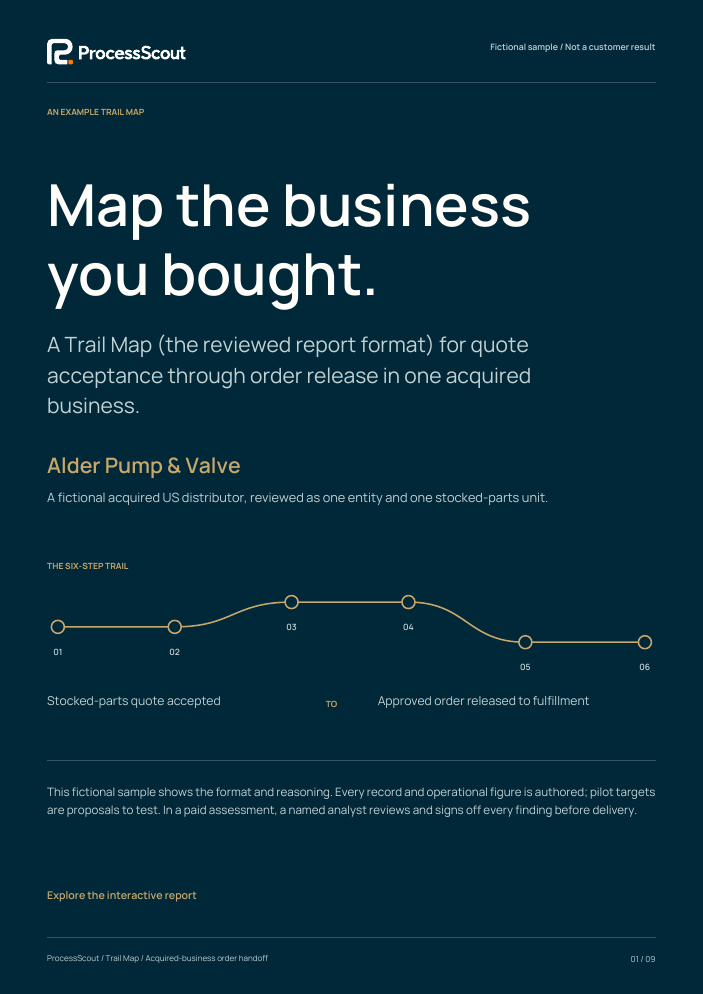
A Trail Map (the reviewed report format) for quote acceptance through order release in one acquired business.

Alder Pump & ValveA fictional acquired US distributor, reviewed as one entity and one stocked-parts unit.
Cover of the Alder Pump & Valve fictional Trail Map

This fictional sample shows the format and reasoning. Every record and operational figure is authored; pilot targets are proposals to test. In a paid assessment, a named analyst reviews and signs off every finding before delivery.

01 / THE DECISION

Make the first move deliberate.

Alder’s accepted quotes still depend on local interpretation before an order can be released. Revised terms and legacy account codes need visible decisions. Preserve that knowledge first, then decide what can be standardized. This example maps the acquired entity; it does not compare two companies.

RECOMMENDED FIRST MOVE

Authorize a one-unit pilot of quote revision control and explicit code interpretation. Keep existing credit and order-release authority until the new handoff has been tested.

  1. 5 sourcesE01 · E02 · E03 · E04 · E05
  2. Preserve the decisionEffort: Low
  3. Define the meaningEffort: Medium
  4. Own the handoffEffort: Low
  5. Decision gateEvery phase ends with one
Illustration · how this fictional report reasons, from evidence to a decision
Scope, cohort and review boundary +

Four authored working weeks; 60 released orders. Fourteen have a post-approval revision, nine need legacy-code interpretation and five of the fourteen revised orders lack a named release resolver. Groups overlap. Timing uses an authored eight-hour weekday clock.

Inside this example

  • One acquired legal entity, one sales unit and stocked-parts orders.
  • Accepted quote, revision, account-code interpretation and release decision.
  • Local knowledge and ownership at the pre-fulfillment handoff.

Outside this example

  • Parent-company workflow comparison, ERP consolidation and organizational integration.
  • Fulfillment, collections, synergy valuation and acquisition diligence.

02 / THE CONNECTED WORKFLOW

From the current trail to a proposed design.

In ProcessScout, the map is drafted from the sources and every step cites where it came from.

ProcessScout / TransformReal product · fictional data
The process step of the ProcessScout demo, with fictional data
Demo workspace for Northstar Services, a different fictional company. Open in the demo ↗
AS-IS / THE WORK TODAYTO-BE / A DESIGN TO VALIDATE
  1. S01Accept quoteSales coordinator+

    Save acceptance; later changes can arrive outside the accepted version.

    System: Quote fileE01 ↗E02 ↗
    T01Pin the accepted versionSales coordinator+

    Record accepted quote ID, version and customer acceptance.

    System: Quote registerE01 ↗E02 ↗
  2. S02Interpret account codeSales administrator+

    Ask an experienced colleague which account treatment the code implies.

    System: Legacy code sheetE02 ↗E03 ↗
    T02Record code meaningData owner+

    Approve legacy meaning and an explicit unknown-code route.

    System: Mapping registerE02 ↗E03 ↗
  3. S03Enter the orderOrder desk+

    Copy approved commercial fields and the interpreted code into an order.

    System: Local ERPE01 ↗E03 ↗
    T03Reconcile order fieldsOrder desk+

    Check account, item, quantity and price against approved sources.

    System: ERP draftE02 ↗E03 ↗
  4. S04Resolve revisionsAccount manager+

    Discuss changed terms; the next release action has no consistent owner.

    System: EmailE02 ↗E04 ↗
    T04Own each revisionAccount manager+

    Name resolver, approval required and next review time.

    System: Revision queueE04 ↗E05 ↗
  5. S05Approve releaseCredit controller+

    Apply existing credit and commercial approval rules.

    System: ERP hold queueE01 ↗E05 ↗
    T05Retain release controlCredit controller+

    Require the existing approvals and retained decision before release.

    System: ERP hold queueE05 ↗
  6. S06Hand to fulfillmentOrder desk+

    Release the order with the supporting quote and revision trail.

    System: Release recordE01 ↗E05 ↗
    T06Release a supported orderOrder desk+

    Link the accepted quote, approved change and code decision.

    System: Versioned release packE01 ↗E05 ↗

Select any step to inspect the owner, system, evidence and proposed response. The target is a design hypothesis, not an implemented process.

03 / THE BASELINE

A number is only useful with its definition.

M01 / business hours / order11.2

Quote-to-release time

Definition and calculation

Elapsed time from quote acceptance to authorized order release.

672 business hours / 60 released orders = 11.2 hours.E01 ↗Released orders exclude open work; elapsed time includes waiting, not just labor.
M02 / released orders14 of 60

Revised after quote approval

Definition and calculation

Orders whose accepted terms change before release.

14 revision flags among 60 unique order IDs.E02 ↗Authored example; compare the same cohort definition in a real pilot.
M03 / released orders9 of 60

Undocumented code interpretation

Definition and calculation

Orders requiring a person to interpret a legacy account code without a retained rule.

9 interpretation flags among the same 60 orders.E02 ↗Authored example; compare the same cohort definition in a real pilot.
M04 / revised orders5 of 14

Release resolver missing

Definition and calculation

Revised orders without a named person to resolve release readiness.

5 missing resolvers among 14 revised orders.E04 ↗The denominator is revised orders; the same order may also need code interpretation.

04 / THREE OPPORTUNITIES

A sequenced set of decisions.

Options sit side by side with their costs, benefits and assumptions, so the choice can be challenged.

ProcessScout / TransformReal product · fictional data
The options step of the ProcessScout demo, with fictional data
Demo workspace for Northstar Services, a different fictional company. Open in the demo ↗
01

01 / Preserve the decision · Effort: Low; version and change checklist

Keep the accepted quote intact.

What the evidence suggests

14 of 60 released orders change after quote approval. Eight of those fourteen lack a linked approval of the revised terms, so the release trail is incomplete.

E02 ↗E04 ↗E05 ↗

The proposed change

Pin the accepted quote version. Record changed fields, customer acceptance and the commercial approver before updating the order. Preserve the previous version so a new owner can understand the decision.

What else could explain it?

Some revisions are valid customer changes. Diagnose which cases reflect missing control before treating the count as preventable.

02

02 / Define the meaning · Effort: Medium; mapping and reconciliation

Make local knowledge transferable.

What the evidence suggests

Nine orders need an undocumented account-code interpretation. The answer exists in a person’s experience, but the next colleague cannot inspect its basis.

E02 ↗E03 ↗

The proposed change

Build a small legacy-code register with meaning, source, effective date and approving owner. Route unknown or conflicting meanings to that owner. Test the interpretation against known orders before suggesting any shared group convention.

What else could explain it?

An unusual account may need legitimate judgment. A mapping should preserve exceptions instead of pretending every code is interchangeable.

03

03 / Own the handoff · Effort: Low; resolver and review cadence

Name the next release decision.

What the evidence suggests

Five of fourteen revised orders lack a release resolver. The credit approver is known, but nobody owns the evidence needed for that decision.

E01 ↗E04 ↗E05 ↗

The proposed change

Give each revised order a resolver, missing-evidence reason and next review time. Keep the credit approver distinct. Use one release-ready pack that links the current quote, code decision and required approvals.

What else could explain it?

Commercial negotiation or credit risk may drive waiting even with clear ownership. Preserve those reasons in the queue.

05 / THE 90-DAY PLAN

Move at the pace the evidence supports.

The chosen option becomes waves of work with owners, still linked to the original finding.

ProcessScout / TransformReal product · fictional data
The blueprint step of the ProcessScout demo, with fictional data
Demo workspace for Northstar Services, a different fictional company. Open in the demo ↗
Days 1-30

Preserve the local decision trail.

Sales lead + acquired-unit owner

  • Confirm the one-entity boundary and replace the authored records.
  • Pilot accepted-version and revision controls.
DECISION GATE

A released order can be traced to authorized customer terms.

Days 31-60

Test the legacy-code meanings.

Data owner + order desk

  • Document recurring interpretations and the unknown-code route.
  • Reconcile mappings against known orders before reuse.
DECISION GATE

No unresolved mapping is treated as an approved operating rule.

Days 61-90

Decide what can be standardized.

Unit manager + integration sponsor

  • Measure the owned release queue and inspect approval quality.
  • Select local changes; scope any cross-entity comparison separately.
DECISION GATE

Retain, revise or stop each pilot on evidence from the acquired unit.

Indicative sequence. Timing depends on evidence readiness, access, owners and approvals. Production implementation requires a separate scope.

06 / THE SOURCE REGISTER

Follow the thread back to the source.

Recordings, documents and spreadsheets sit in one place, and each finding links back to its source.

ProcessScout / TransformReal product · fictional data
The sources step of the ProcessScout demo, with fictional data
Demo workspace for Northstar Services, a different fictional company. Open in the demo ↗
E01

Acquired-unit order trail

Synthetic event register
+
Evidence boundary
60 released stocked-parts orders over four weeks.
What it supports
Accepted-quote to release intervals total 672 business hours. Order IDs join quote, entry and release; the mean is 11.2 hours.
Interpretation note
The interval includes waiting. Open orders need a separate age view.
E02

Quote and legacy-code workbook

Authored field audit
+
Evidence boundary
The same 60 order IDs and accepted quote versions.
What it supports
14 orders change after quote approval. Nine require undocumented account-code interpretation. Their overlapping flags stay attached to the order.
Interpretation note
A legacy code may be valid local knowledge. Its meaning must be established before replacement.
E03

Sales-to-credit handover walkthrough

Authored walkthrough
+
Evidence boundary
ALD-006 / quote Q-841 revision 2, before order release.
What it supports
The customer changes quantity. A credit lead explains the legacy account condition; sales updates the order, but the revised approval is not linked to the release record.
Interpretation note
This illustrates a knowledge and evidence dependency; interviews must test how often it arises.
E04

Revision release queue

Synthetic ownership review
+
Evidence boundary
The fourteen orders revised after quote approval.
What it supports
Five revised orders have no release resolver. Eight of the fourteen revised orders also lack a retained approval link for the changed terms. The categories overlap.
Interpretation note
Resolver and approver are different roles. A blank field alone does not explain delay.
E05

Local release authority

Authored procedure excerpt
+
Evidence boundary
Credit release, commercial changes and fulfillment handoff.
What it supports
Credit and commercial approvals remain separate. A quote change needs authorized acceptance before the order can leave the hold queue.
Interpretation note
A one-entity map cannot justify adopting or removing controls across the group.

Assumptions to replace

  • All 60 released orders and their timings are invented.
  • Revision, code and ownership groups overlap.
  • No integration savings or parent-company comparison is claimed.

Questions before action

  • Sales lead: distinguish legitimate changes from avoidable rework.
  • Data owner: approve the meaning and authority of legacy codes.
  • Sponsor: define any later cross-entity comparison separately.

Take the working example with you.

The same evidence, reasoning and next step in a nine-page PDF.

Download PDF ↓
Technical details

Inspect the authored record rows and report schema behind this example.

Download structured sample data (JSON) ↓

PROCESSSCOUT EDGE / GUIDED ASSESSMENT

Make this your workflow.

Edge is ProcessScout’s guided assessment service for one recurring workflow.

$1,500 USD paid upfront

One legal entity, one business unit and one workflow.

What you receive

A Trail Map (the reviewed report you receive), three prioritized opportunities, a baseline and a sequenced 90-day plan.

One supported starter asset: an SOP, control checklist, requirements specification or automation blueprint. Production implementation is a separate engagement.

Five business days after your evidence checklist is complete.

The clock starts when sources, recordings, documents, interview and blocking questions are complete. Payment alone does not start it.

David Bell

David Bell ↗ProcessScout review lead

25 years in operations and finance, including Shell and Deutsche Bank; founder and CEO of JustPayroll through its 2024 acquisition.

David Bell leads the review approach. The analyst assigned to your assessment owns its recommendations and sign-off.

Three opportunities, or your fee back

If ProcessScout cannot identify at least three evidence-backed opportunities from a good-faith intake, the assessment fee is refunded under the assessment terms. This is a deliverable guarantee, not a promise of realized savings.

Read the assessment terms ↗

Cancellation and scope protection

Cancel before analyst review starts for a full refund. If the report materially misses the agreed brief, tell us within 14 days of full access and choose an in-scope correction or a refund after review.

Read the full protection policy ↗
Book a 15-minute fit call

Bring one workflow and the decision you need to make.
The call scopes fit; it is not the assessment itself.