Skip to content

THE TRAIL MAP / FICTIONAL SAMPLE

Dispatch and scheduling.
The work, made clear.

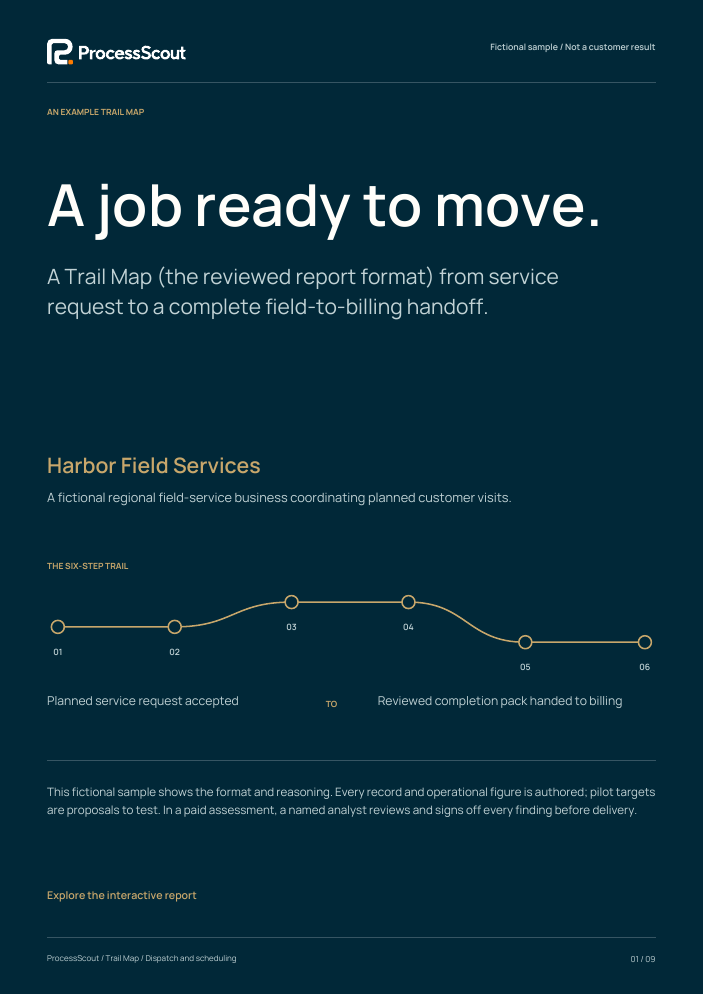
A Trail Map (the reviewed report format) from service request to a complete field-to-billing handoff.

Harbor Field ServicesA fictional regional field-service business coordinating planned customer visits.
Cover of the Harbor Field Services fictional Trail Map

This fictional sample shows the format and reasoning. Every record and operational figure is authored; pilot targets are proposals to test. In a paid assessment, a named analyst reviews and signs off every finding before delivery.

01 / THE DECISION

Make the first move deliberate.

A visible slot is not the same as a ready job. In the authored example, dispatch readiness and completion evidence are checked late, while some exceptions have no clear resolver. Establish the ready-to-dispatch decision, then make rescheduling and field completion owned.

RECOMMENDED FIRST MOVE

Pilot a readiness gate on one job type and service area. Keep dispatch approval, technician competence and customer commitments under accountable human control.

  1. 5 sourcesE01 · E02 · E03 · E04 · E05
  2. Establish readinessEffort: Low
  3. Close the exception loopEffort: Low
  4. Capture at completionEffort: Medium
  5. Decision gateEvery phase ends with one
Illustration · how this fictional report reasons, from evidence to a decision
Scope, cohort and review boundary +

One example two-week planning cohort; 30 completed jobs reviewed before dispatch and through billing readiness. Eight have a readiness exception; six have an incomplete completion pack later. Those groups may overlap and do not sum to fourteen distinct jobs. Timing uses an authored eight-hour weekday clock.

Inside this example

  • One fictional service area and one planned job category.
  • Job intake, readiness, assignment, dispatch, completion and billing handoff.
  • People, evidence and exceptions at those handoffs.

Outside this example

  • Emergency response, route optimization and staffing-level design.
  • Safety certification, live location monitoring and invoice collection.

02 / THE CONNECTED WORKFLOW

From the current trail to a proposed design.

In ProcessScout, the map is drafted from the sources and every step cites where it came from.

ProcessScout / TransformReal product · fictional data
The process step of the ProcessScout demo, with fictional data
Demo workspace for Northstar Services, a different fictional company. Open in the demo ↗
AS-IS / THE WORK TODAYTO-BE / A DESIGN TO VALIDATE
  1. S01Receive the requestService coordinator+

    Create a job with customer need, location and requested window.

    System: CRM + shared inboxE01 ↗E03 ↗
    T01Capture the job boundaryService coordinator+

    Record access, scope, contact, constraints and required job evidence.

    System: Intake checklistE02 ↗E03 ↗
  2. S02Place a provisional slotScheduler+

    Hold time before access, parts and job details are fully checked.

    System: Schedule boardE02 ↗E03 ↗
    T02Make readiness explicitScheduler+

    Distinguish a provisional slot from a job approved for dispatch.

    System: Ready / waiting statusE02 ↗E05 ↗
  3. S03Check readinessDispatcher+

    Look for missing details; exception ownership is not consistent.

    System: Job notes + checklistE02 ↗
    T03Own each exceptionNamed resolver+

    Assign missing access, parts or information to an owner with a next review.

    System: Exception queueE02 ↗
  4. S04Assign and dispatchDispatcher+

    Confirm the technician and send job information for the visit.

    System: Dispatch boardE01 ↗E05 ↗
    T04Approve dispatchDispatcher+

    Confirm readiness and technician suitability before releasing the job.

    System: Controlled dispatch boardE05 ↗
  5. S05Complete the visitField technician+

    Record work performed; required proof can remain outside the job record.

    System: Mobile job notesE03 ↗E04 ↗
    T05Capture completion at sourceField technician+

    Attach required work notes, time, materials and customer acknowledgment where applicable.

    System: Job-linked completion formE04 ↗
  6. S06Hand off to billingService administrator+

    Check the pack and chase missing details before billing preparation.

    System: Completion inboxE04 ↗E05 ↗
    T06Review a complete handoffService administrator+

    Accept or return the pack with a named reason; billing retains its review.

    System: Billing-readiness queueE04 ↗E05 ↗

Select any step to inspect the owner, system, evidence and proposed response. The target is a design hypothesis, not an implemented process.

03 / THE BASELINE

A number is only useful with its definition.

M01 / business hours / job6

Completion-to-billing-ready time

Definition and calculation

Elapsed business-clock time from recorded completion to a reviewed billing-ready pack.

180 business hours / 30 completed jobs = 6 hours.E01 ↗Includes waiting. It does not measure technician time, invoice issuance or collection.
M02 / example jobs8 of 30

Readiness exceptions

Definition and calculation

Jobs failing at least one required readiness check before dispatch.

8 unique jobs fail a readiness check among 30 planned jobs.E02 ↗A failed check is not proof of a late visit, failed job or safety incident.
M03 / example jobs6 of 30

Incomplete completion packs

Definition and calculation

Jobs missing a required handoff item when completion evidence is reviewed.

6 incomplete packs among the same 30 completed jobs.E04 ↗These six may overlap with readiness exceptions; they are not additive.
M04 / readiness exceptions5 of 8

Exceptions without an owner

Definition and calculation

Readiness exceptions lacking a named resolver in the authored planning queue.

5 unassigned items among 8 readiness exceptions.E02 ↗The denominator is eight exceptions, not thirty jobs.

04 / THREE OPPORTUNITIES

A sequenced set of decisions.

Options sit side by side with their costs, benefits and assumptions, so the choice can be challenged.

ProcessScout / TransformReal product · fictional data
The options step of the ProcessScout demo, with fictional data
Demo workspace for Northstar Services, a different fictional company. Open in the demo ↗
01

01 / Establish readiness · Effort: Low; job checklist and status rules

Separate a booked slot from a ready job.

What the evidence suggests

Eight of 30 example jobs fail a readiness check before dispatch. A slot on the schedule does not confirm access, parts, information or technician suitability.

E01 ↗E02 ↗E03 ↗

The proposed change

Define the minimum ready-to-dispatch evidence for one job type. Mark provisional, waiting and ready states visibly. Record the missing item and its resolver early enough for a human to decide whether to confirm, hold or reschedule the visit.

What else could explain it?

A supplier shortage or customer access problem may remain even with an earlier check. Separate preventable information gaps from constraints the scheduler cannot remove.

02

02 / Close the exception loop · Effort: Low; resolver rules and daily review

Give rescheduling a visible owner.

What the evidence suggests

Five of eight readiness exceptions have no named resolver in the authored queue. The schedule may change without a clear record of who confirms the next action with the customer.

E02 ↗E03 ↗E05 ↗

The proposed change

Assign each exception a resolver, next action, next review and escalation owner. Link reschedule decisions back to the job. Make customer communication a named responsibility and retain the original commitment and reason for change.

What else could explain it?

Work may already be owned informally, and the issue may be decision authority or unavailable parts. Review actual next actions, not just whether an owner field is filled.

03

03 / Capture at completion · Effort: Medium; job form and review protocol

Finish the field-to-billing handoff.

What the evidence suggests

Six of the 30 example completion packs lack a required item. The administrator reconstructs the handoff after the technician has moved to other work.

E01 ↗E04 ↗E05 ↗

The proposed change

Create a job-type-specific completion checklist with linked work notes, time, materials and acknowledgment where applicable. Let the reviewer accept or return a pack with a reason and owner. Preserve original field entries and subsequent corrections.

What else could explain it?

Requirements may vary by job type, or connectivity may delay uploads. Define what is truly required and distinguish missing work evidence from a delayed sync before expanding the form.

05 / THE 90-DAY PLAN

Move at the pace the evidence supports.

The chosen option becomes waves of work with owners, still linked to the original finding.

ProcessScout / TransformReal product · fictional data
The blueprint step of the ProcessScout demo, with fictional data
Demo workspace for Northstar Services, a different fictional company. Open in the demo ↗
Days 1-30

Define the dispatch-ready job.

Dispatch lead + coordinator

  • Agree one job type, the required evidence and authority to override.
  • Replace sample counts and pilot ready / waiting / provisional status.
DECISION GATE

Readiness is visible; no unsupported dispatch or hidden deferred backlog.

Days 31-60

Close the reschedule loop.

Scheduling lead

  • Assign resolvers, customer-contact responsibility and escalation.
  • Review exceptions daily and retain the original schedule commitment.
DECISION GATE

All pilot exceptions have an actionable owner and an explicit contact decision.

Days 61-90

Make completion reviewable.

Field service + billing lead

  • Pilot the job-specific completion pack and inspect returned packs.
  • Record the scale, revise or stop decision and maintain a fallback.
DECISION GATE

Evidence quality holds; billing retains review; no financial result is assumed.

Indicative sequence. Timing depends on evidence readiness, access, owners and approvals. Production implementation requires a separate scope.

06 / THE SOURCE REGISTER

Follow the thread back to the source.

Recordings, documents and spreadsheets sit in one place, and each finding links back to its source.

ProcessScout / TransformReal product · fictional data
The sources step of the ProcessScout demo, with fictional data
Demo workspace for Northstar Services, a different fictional company. Open in the demo ↗
E01

Planned-job register

Synthetic business records
+
Evidence boundary
30 invented job IDs in one two-week planning window.
What it supports
30 job trails total 180 business hours from completion to billing-ready review, averaging 6 hours. The same job IDs connect readiness, dispatch and completion evidence.
Interpretation note
The authored clock includes waiting. Compare like job types and define business hours before testing a real billing-handoff change.
E02

Readiness and ownership sheet

Synthetic planning checklist
+
Evidence boundary
All 30 jobs; eight readiness exceptions.
What it supports
Eight jobs fail at least one required readiness check. Five of those eight lack a named resolver. A provisional slot and a ready job are different states.
Interpretation note
A check can fail for different reasons; the sample does not show whether access, parts, customer detail or staffing dominates.
E03

Dispatch desk walkthrough

Authored walkthrough capture
+
Evidence boundary
A fictional path through intake, schedule board and field notes.
What it supports
For JOB-005, the customer changes access instructions. The scheduler updates the board and calls the supervisor, while field notes still show the previous instruction and the access contact is unconfirmed.
Interpretation note
No actual screen recording, employee observation, route model or integration feasibility is claimed.
E04

Completion-pack audit

Synthetic handoff checklist
+
Evidence boundary
Completion review of the same 30 jobs.
What it supports
Six packs lack at least one required item. The check records work notes, time, materials and acknowledgment only where relevant to the job type.
Interpretation note
A missing pack item does not prove unbilled revenue or failed work. Completion and readiness gaps can occur on the same job.
E05

Dispatch and handoff rules

Authored procedure excerpt
+
Evidence boundary
Readiness, release, reschedule and billing-handoff decisions.
What it supports
The dispatcher remains accountable for release. A proposed exception route needs an owner, a customer-contact decision and a controlled return to planning.
Interpretation note
Real competence, safety, working-time and customer requirements must be confirmed for the specific service context.

Assumptions to replace

  • Thirty invented jobs define the counts and elapsed-time mean.
  • Readiness and completion exceptions can overlap.
  • Targets concern evidence and ownership, not service guarantees.

Questions before action

  • Dispatch lead: confirm job-type-specific safety and competence requirements.
  • Scheduler: distinguish information gaps from parts, access and capacity constraints.
  • Billing lead: validate required completion evidence and record retention.

Take the working example with you.

The same evidence, reasoning and next step in a nine-page PDF.

Download PDF ↓
Technical details

Inspect the authored record rows and report schema behind this example.

Download structured sample data (JSON) ↓

PROCESSSCOUT EDGE / GUIDED ASSESSMENT

Make this your workflow.

Edge is ProcessScout’s guided assessment service for one recurring workflow.

$1,500 USD paid upfront

One legal entity, one business unit and one workflow.

What you receive

A Trail Map (the reviewed report you receive), three prioritized opportunities, a baseline and a sequenced 90-day plan.

One supported starter asset: an SOP, control checklist, requirements specification or automation blueprint. Production implementation is a separate engagement.

Five business days after your evidence checklist is complete.

The clock starts when sources, recordings, documents, interview and blocking questions are complete. Payment alone does not start it.

David Bell

David Bell ↗ProcessScout review lead

25 years in operations and finance, including Shell and Deutsche Bank; founder and CEO of JustPayroll through its 2024 acquisition.

David Bell leads the review approach. The analyst assigned to your assessment owns its recommendations and sign-off.

Three opportunities, or your fee back

If ProcessScout cannot identify at least three evidence-backed opportunities from a good-faith intake, the assessment fee is refunded under the assessment terms. This is a deliverable guarantee, not a promise of realized savings.

Read the assessment terms ↗

Cancellation and scope protection

Cancel before analyst review starts for a full refund. If the report materially misses the agreed brief, tell us within 14 days of full access and choose an in-scope correction or a refund after review.

Read the full protection policy ↗
Book a 15-minute fit call

Bring one workflow and the decision you need to make.
The call scopes fit; it is not the assessment itself.