Skip to content

THE TRAIL MAP / FICTIONAL SAMPLE

Freight exception handoff.
The work, made clear.

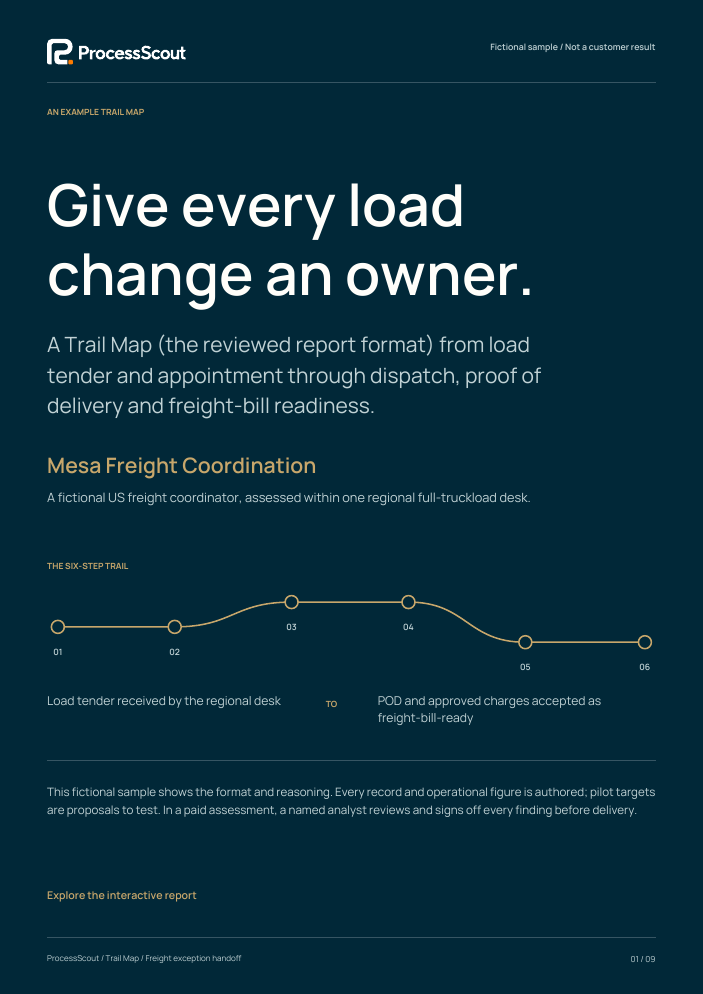
A Trail Map (the reviewed report format) from load tender and appointment through dispatch, proof of delivery and freight-bill readiness.

Mesa Freight CoordinationA fictional US freight coordinator, assessed within one regional full-truckload desk.
Cover of the Mesa Freight Coordination fictional Trail Map

This fictional sample shows the format and reasoning. Every record and operational figure is authored; pilot targets are proposals to test. In a paid assessment, a named analyst reviews and signs off every finding before delivery.

01 / THE DECISION

Make the first move deliberate.

Mesa’s load changes are visible in messages but not consistently reflected in the accepted plan or billing evidence. Appointment changes, proof of delivery and accessorial authority need separate owners and records. Start with the handoff that keeps the carrier, customer and billing desk aligned.

RECOMMENDED FIRST MOVE

Pilot acknowledged appointment changes, linked proof of delivery and explicit accessorial approval on one regional desk. Keep carrier acceptance and commercial authority with authorized people.

  1. 5 sourcesE01 · E02 · E03 · E04 · E05
  2. Control the changeEffort: Low
  3. Complete the freight packEffort: Low
  4. Protect the charge decisionEffort: Medium
  5. Decision gateEvery phase ends with one
Illustration · how this fictional report reasons, from evidence to a decision
Scope, cohort and review boundary +

Four authored working weeks; 48 completed loads. Thirteen have changed appointments, seven lack POD at first bill review and five of nine accessorial requests lack shipper approval. The groups overlap and have different denominators. Timing uses an authored eight-hour weekday clock.

Inside this example

  • One legal entity, one regional desk and full-truckload coordination.
  • Tender, appointment, carrier dispatch, proof of delivery and accessorial evidence.
  • Load changes and the handoff from operations to freight billing.

Outside this example

  • Carrier qualification, safety certification and route optimization.
  • Cargo claims, rate procurement, bill payment and collection.

02 / THE CONNECTED WORKFLOW

From the current trail to a proposed design.

In ProcessScout, the map is drafted from the sources and every step cites where it came from.

ProcessScout / TransformReal product · fictional data
The process step of the ProcessScout demo, with fictional data
Demo workspace for Northstar Services, a different fictional company. Open in the demo ↗
AS-IS / THE WORK TODAYTO-BE / A DESIGN TO VALIDATE
  1. S01Receive load tenderLoad planner+

    Record lane, equipment, commodity and customer reference.

    System: TMS tenderE01 ↗E03 ↗
    T01Confirm the tenderLoad planner+

    Retain accepted requirements and the unique load reference.

    System: Accepted load recordE01 ↗E03 ↗
  2. S02Set the appointmentAppointment coordinator+

    Book the slot; a later change can live only in a message.

    System: Email + facility portalE02 ↗E03 ↗
    T02Version the appointmentAppointment coordinator+

    Record old and new time, facility and the reason for change.

    System: Appointment logE02 ↗E04 ↗
  3. S03Dispatch the carrierCarrier dispatcher+

    Pass the plan and revised instructions to the accepted carrier.

    System: TMS + carrier messageE01 ↗E04 ↗
    T03Acknowledge the changeCarrier dispatcher+

    Retain the carrier acknowledgement of the current plan.

    System: Dispatch confirmationE03 ↗E04 ↗
  4. S04Track the exceptionOperations desk+

    Record changed appointments and accessorial requests while the load moves.

    System: Load notesE02 ↗E05 ↗
    T04Own the charge decisionOperations desk+

    Record charge basis, shipper authority and pending decision.

    System: Accessorial queueE05 ↗
  5. S05Collect delivery proofDocument coordinator+

    Find proof of delivery and link it to the completed load.

    System: POD inboxE01 ↗E02 ↗
    T05Reconcile the PODDocument coordinator+

    Check load, location and required delivery evidence before closure.

    System: Linked delivery evidenceE01 ↗E02 ↗
  6. S06Prepare the freight billFreight billing analyst+

    Match tender, POD and accessorial authority before billing readiness.

    System: Billing workbookE01 ↗E05 ↗
    T06Accept bill readinessFreight billing lead+

    Reconcile approved charges and POD to the accepted tender.

    System: Supported freight packE01 ↗E05 ↗

Select any step to inspect the owner, system, evidence and proposed response. The target is a design hypothesis, not an implemented process.

03 / THE BASELINE

A number is only useful with its definition.

M01 / business hours / load10.5

Delivery-to-bill-ready time

Definition and calculation

Elapsed time from recorded delivery to an accepted freight-bill-ready pack.

504 business hours / 48 completed loads = 10.5 hours.E01 ↗Includes document waiting; it is not transit time, dispatcher labor or days to payment.
M02 / completed loads13 of 48

Appointment changed

Definition and calculation

Loads with at least one revised pickup or delivery appointment.

13 changed-appointment flags among 48 load IDs.E02 ↗A change is not automatically a failure. Check who received and accepted the revision.
M03 / completed loads7 of 48

POD missing at first review

Definition and calculation

Loads without the required proof of delivery in the first billing pack.

7 missing POD flags among 48 loads.E02 ↗Authored example; compare the same cohort definition in a real pilot.
M04 / accessorial requests5 of 9

Shipper approval missing

Definition and calculation

Accessorial requests without the required shipper approval evidence.

5 unapproved requests among 9 accessorial requests.E05 ↗The denominator is requests, not loads; approval must be checked against the agreed commercial terms.

04 / THREE OPPORTUNITIES

A sequenced set of decisions.

Options sit side by side with their costs, benefits and assumptions, so the choice can be challenged.

ProcessScout / TransformReal product · fictional data
The options step of the ProcessScout demo, with fictional data
Demo workspace for Northstar Services, a different fictional company. Open in the demo ↗
01

01 / Control the change · Effort: Low; change log and acknowledgement

Make the revised appointment visible.

What the evidence suggests

Thirteen of forty-eight loads have changed appointments; six of those thirteen lack retained carrier acknowledgement. The revised facility time is separate from the carrier’s current plan.

E02 ↗E03 ↗E04 ↗

The proposed change

Use one versioned appointment record linked to the load. Name the owner, retain the old and new instruction, notify the relevant parties and record carrier acknowledgement. Keep an unconfirmed revision open rather than treating a sent message as acceptance.

What else could explain it?

Some changes occur after dispatch or are imposed by the facility. Measure communication completeness rather than assuming all changes are preventable.

02

02 / Complete the freight pack · Effort: Low; evidence checklist and queue

Connect delivery proof to the load.

What the evidence suggests

Seven loads lack required POD at first billing review. Billing must chase evidence after operations has marked the movement complete.

E01 ↗E02 ↗E03 ↗

The proposed change

Define the required POD by customer and attach it to the load reference. Record document status, reason, resolver and next review time. Reconcile the evidence to the correct load and delivery location before the pack enters billing review.

What else could explain it?

Document timing may depend on the carrier or facility. Separate external waiting from avoidable internal search and linkage.

03

03 / Protect the charge decision · Effort: Medium; authority and charge evidence

Keep accessorial approval explicit.

What the evidence suggests

Five of nine accessorial requests lack required shipper approval. A delay note or carrier request does not establish authority to bill the customer.

E01 ↗E04 ↗E05 ↗

The proposed change

Link the requested charge, contract basis, event evidence and shipper decision to the load. Name who seeks approval and who decides billing readiness. Preserve denied or disputed requests so the record does not imply that every requested charge is recoverable.

What else could explain it?

Some contract terms preauthorize a charge. Confirm whether separate approval is required before counting a missing email as a gap.

05 / THE 90-DAY PLAN

Move at the pace the evidence supports.

The chosen option becomes waves of work with owners, still linked to the original finding.

ProcessScout / TransformReal product · fictional data
The blueprint step of the ProcessScout demo, with fictional data
Demo workspace for Northstar Services, a different fictional company. Open in the demo ↗
Days 1-30

Rehearse the changed load.

Dispatch lead + carrier coordinator

  • Replace sample records and define appointment authority.
  • Pilot versioned instructions and acknowledgement.
DECISION GATE

The carrier can identify the current accepted plan.

Days 31-60

Link proof to billing readiness.

POD coordinator + billing lead

  • Define customer-specific POD requirements.
  • Measure missing documents, queue age and comparable elapsed time.
DECISION GATE

Packs contain correct evidence; unresolved loads remain visible.

Days 61-90

Test the charge decision trail.

Customer operations + finance

  • Review accessorial basis, evidence and approval.
  • Decide whether to retain, revise or expand the desk’s pilot.
DECISION GATE

Only supported, authorized charges enter a bill-ready pack.

Indicative sequence. Timing depends on evidence readiness, access, owners and approvals. Production implementation requires a separate scope.

06 / THE SOURCE REGISTER

Follow the thread back to the source.

Recordings, documents and spreadsheets sit in one place, and each finding links back to its source.

ProcessScout / TransformReal product · fictional data
The sources step of the ProcessScout demo, with fictional data
Demo workspace for Northstar Services, a different fictional company. Open in the demo ↗
E01

Tender-to-freight-bill trail

Synthetic load event register
+
Evidence boundary
48 completed loads on one regional FTL desk.
What it supports
Delivery-to-bill-ready intervals total 504 business hours, averaging 10.5 hours. One load ID links tender, appointment, dispatch, POD and billing pack.
Interpretation note
Completed loads omit open document queues. Keep aging loads visible alongside the mean.
E02

POD and accessorial workbook

Authored exception audit
+
Evidence boundary
48 load packs, appointment history and nine accessorial requests.
What it supports
13 loads have a changed appointment; 7 lack POD at first review; 5 of 9 accessorial requests lack shipper approval. MES-011 links revision 2 and detention times to the unresolved charge decision.
Interpretation note
POD and approval gaps overlap. Retain appointment history and apply the actual customer evidence requirements.
E03

Planner-to-carrier walkthrough

Authored dispatch walkthrough
+
Evidence boundary
A tender is accepted, reappointed and passed to the carrier.
What it supports
The facility changes a delivery slot in email; the dispatch note still shows the previous time until the planner updates it and asks for acknowledgement.
Interpretation note
This is a fictional handoff, not a live tracking feed or a transport-performance claim.
E04

Appointment change control

Authored procedure excerpt
+
Evidence boundary
Facility, customer and carrier communication after a revision.
What it supports
Six of thirteen changed loads lack retained carrier acknowledgement. The proposed record keeps old and new plans, reason, owner and acknowledgement together.
Interpretation note
The desk must confirm which party can authorize each change; acknowledgement does not alter the contract.
E05

Detailed accessorial approval audit

Synthetic charge review
+
Evidence boundary
The nine requests in the E02 workbook, linked to the 48-load cohort.
What it supports
Five requests lack required shipper approval. Each request records charge type, reason, supporting evidence and the commercial decision separately.
Interpretation note
A requested charge is not earned revenue. Apply the actual contract and retain disputed or denied requests.

Assumptions to replace

  • All 48 loads, nine requests and timings are authored.
  • Changed appointments are not inherently service failures.
  • Readiness, transit, revenue and cash are different measures.

Questions before action

  • Dispatch lead: confirm appointment and communication authority.
  • Billing lead: validate customer-specific POD requirements.
  • Commercial owner: confirm accessorial terms and approval rules.

Take the working example with you.

The same evidence, reasoning and next step in a nine-page PDF.

Download PDF ↓
Technical details

Inspect the authored record rows and report schema behind this example.

Download structured sample data (JSON) ↓

PROCESSSCOUT EDGE / GUIDED ASSESSMENT

Make this your workflow.

Edge is ProcessScout’s guided assessment service for one recurring workflow.

$1,500 USD paid upfront

One legal entity, one business unit and one workflow.

What you receive

A Trail Map (the reviewed report you receive), three prioritized opportunities, a baseline and a sequenced 90-day plan.

One supported starter asset: an SOP, control checklist, requirements specification or automation blueprint. Production implementation is a separate engagement.

Five business days after your evidence checklist is complete.

The clock starts when sources, recordings, documents, interview and blocking questions are complete. Payment alone does not start it.

David Bell

David Bell ↗ProcessScout review lead

25 years in operations and finance, including Shell and Deutsche Bank; founder and CEO of JustPayroll through its 2024 acquisition.

David Bell leads the review approach. The analyst assigned to your assessment owns its recommendations and sign-off.

Three opportunities, or your fee back

If ProcessScout cannot identify at least three evidence-backed opportunities from a good-faith intake, the assessment fee is refunded under the assessment terms. This is a deliverable guarantee, not a promise of realized savings.

Read the assessment terms ↗

Cancellation and scope protection

Cancel before analyst review starts for a full refund. If the report materially misses the agreed brief, tell us within 14 days of full access and choose an in-scope correction or a refund after review.

Read the full protection policy ↗
Book a 15-minute fit call

Bring one workflow and the decision you need to make.
The call scopes fit; it is not the assessment itself.