Inside this example
- One fictional legal entity and one management-close cycle.
- Twenty selected tasks, supporting evidence, review and pack assembly.
- Task owners, reviewers, backups and version control.

THE TRAIL MAP / FICTIONAL SAMPLE
A Trail Map (the reviewed report format) from close task to reviewed, versioned management pack.
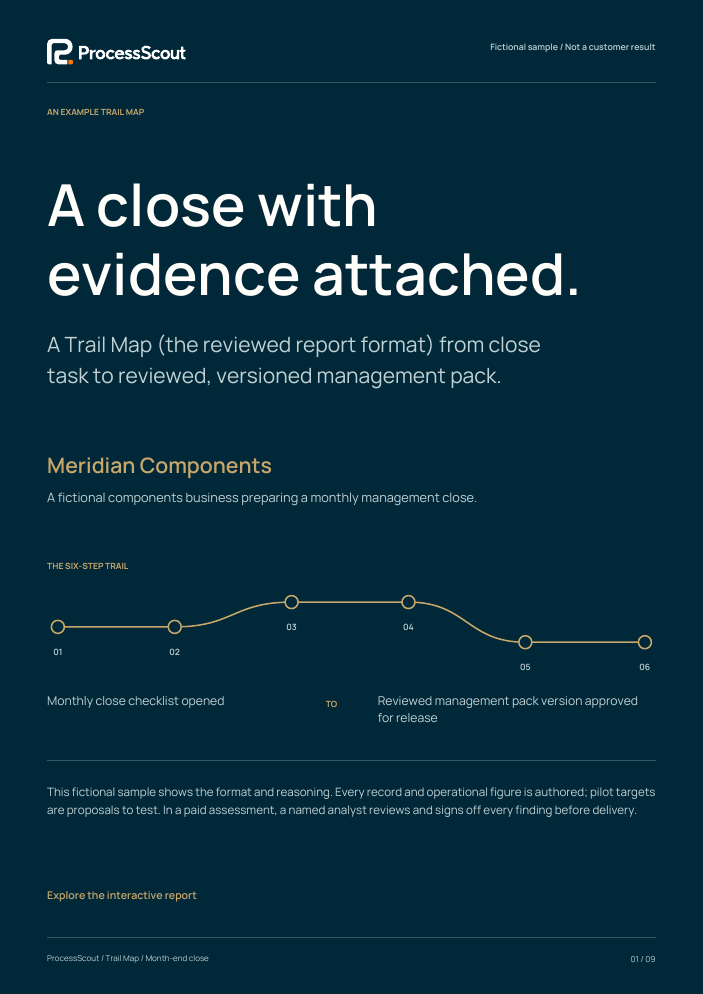
This fictional sample shows the format and reasoning. Every record and operational figure is authored; pilot targets are proposals to test. In a paid assessment, a named analyst reviews and signs off every finding before delivery.
01 / THE DECISION
A green task status is useful only when a reviewer can inspect the work behind it. In this authored close, missing support, waiting review and weak backup coverage make progress hard to judge. Standardize the evidence first, then own the review queue and the final pack version.
Pilot evidence-linked task completion and a named review queue for one close cycle. Keep preparation, review and posting authority distinct.
One illustrative month-end snapshot covering 20 selected close tasks. Six lack linked support, four await reviewer action and three lack a named backup. The categories can overlap; they are not thirteen distinct delayed tasks. Timing uses an authored eight-hour weekday clock.
02 / THE CONNECTED WORKFLOW
In ProcessScout, the map is drafted from the sources and every step cites where it came from.

Record extract date, source reference and reconciliation before submission.
System: Controlled working fileE02 ↗Link approved task versions and reconcile pack totals to their sources.
System: Versioned management packE05 ↗Select any step to inspect the owner, system, evidence and proposed response. The target is a design hypothesis, not an implemented process.
03 / THE BASELINE
Elapsed business-clock time for the 16 decided tasks in the 20-task snapshot.
96 business hours / 16 decided tasks = 6 hours.E01 ↗Four awaiting decisions are excluded. This is not total close duration or reviewer labor.Tasks without the required linked reconciliation or supporting file at the snapshot.
6 task IDs lack a support link among 20 selected tasks.E02 ↗Missing linkage does not establish an accounting error or absent underlying work.Tasks submitted for review but with no recorded review decision at the snapshot.
4 task IDs await a decision among 20 selected tasks.E02 ↗A snapshot is not a review-duration or missed-deadline measurement.Selected tasks without a documented backup for the assigned owner.
3 task IDs lack a backup among 20 selected tasks.E04 ↗The three can overlap support and review gaps; their impact is unmeasured.04 / THREE OPPORTUNITIES
Options sit side by side with their costs, benefits and assumptions, so the choice can be challenged.

01 / Establish the evidence · Effort: Low; task evidence standards
Six of 20 example tasks lack a required support link. A green or submitted status does not give the reviewer a stable route back to the reconciliation and source.
E01 ↗E02 ↗E03 ↗Define required support by task type. Record the source extract reference, relevant period, reconciliation and supporting-file version. Make ready-for-review mean that those items are present, with explicit exceptions for evidence still pending.
The support may exist elsewhere, or task requirements may be unclear. Distinguish absent work from poor linkage and unnecessary documentation before adding steps.
02 / Own the review · Effort: Low; review status and cadence
Four of 20 example tasks await reviewer action at the snapshot. Their waiting age is separate from the 6-hour mean for decided tasks; keep both the backlog and completed reviews visible.
E01 ↗E02 ↗E03 ↗Give every submitted task a named reviewer, next review point and accepted / returned / waiting status. Keep review questions and resolution evidence linked to the task. Make escalation explicit when the reviewer lacks time, authority or complete support.
The snapshot may fall just before a scheduled review batch. Capture submitted and decided timestamps to separate normal cadence from a blocked handoff.
03 / Protect the final handoff · Effort: Medium; version and coverage discipline
Three of 20 selected tasks have no named backup. The authored walkthrough also separates working files from pack assembly, so ownership and source version need to be visible at release.
E03 ↗E04 ↗E05 ↗Assign a competent backup for each in-scope task and define when coverage is invoked. Assemble one versioned pack from approved task outputs, record the source versions and name the release approver. Replace a released pack only through a recorded review and a new version.
A named backup may lack actual capacity or system access. Test a real handover in the authorized pilot and treat an unproven name in a roster as an open gap.
05 / THE 90-DAY PLAN
The chosen option becomes waves of work with owners, still linked to the original finding.

Close coordinator + preparers
Support is present, period-correct and reconciled; no premature completion.
Controller + reviewers
Review quality holds and returned or waiting work remains visible.
Controller + finance analyst
Coverage works; every pack figure traces to its source; release authority is intact.
Indicative sequence. Timing depends on evidence readiness, access, owners and approvals. Production implementation requires a separate scope.
06 / THE SOURCE REGISTER
Recordings, documents and spreadsheets sit in one place, and each finding links back to its source.

The same evidence, reasoning and next step in a nine-page PDF.
Inspect the authored record rows and report schema behind this example.
Download structured sample data (JSON) ↓PROCESSSCOUT EDGE / GUIDED ASSESSMENT
Edge is ProcessScout’s guided assessment service for one recurring workflow.
$1,500 USD paid upfront
One legal entity, one business unit and one workflow.
A Trail Map (the reviewed report you receive), three prioritized opportunities, a baseline and a sequenced 90-day plan.
One supported starter asset: an SOP, control checklist, requirements specification or automation blueprint. Production implementation is a separate engagement.
The clock starts when sources, recordings, documents, interview and blocking questions are complete. Payment alone does not start it.

David Bell ↗ProcessScout review lead
25 years in operations and finance, including Shell and Deutsche Bank; founder and CEO of JustPayroll through its 2024 acquisition.
David Bell leads the review approach. The analyst assigned to your assessment owns its recommendations and sign-off.
If ProcessScout cannot identify at least three evidence-backed opportunities from a good-faith intake, the assessment fee is refunded under the assessment terms. This is a deliverable guarantee, not a promise of realized savings.
Read the assessment terms ↗Cancel before analyst review starts for a full refund. If the report materially misses the agreed brief, tell us within 14 days of full access and choose an in-scope correction or a refund after review.
Read the full protection policy ↗Bring one workflow and the decision you need to make.
The call scopes fit; it is not the assessment itself.
Allow optional analytics to help us improve ProcessScout? Privacy notice