Inside this example
- One legal entity, one returns unit and returned-stock cases.
- Return authorization, receipt, item mapping, disposition and draft credit.
- Evidence and requirements needed before an ERP migration.

THE TRAIL MAP / FICTIONAL SAMPLE
A Trail Map (the reviewed report format) for authorized return, receipt, disposition and draft credit before a system change.
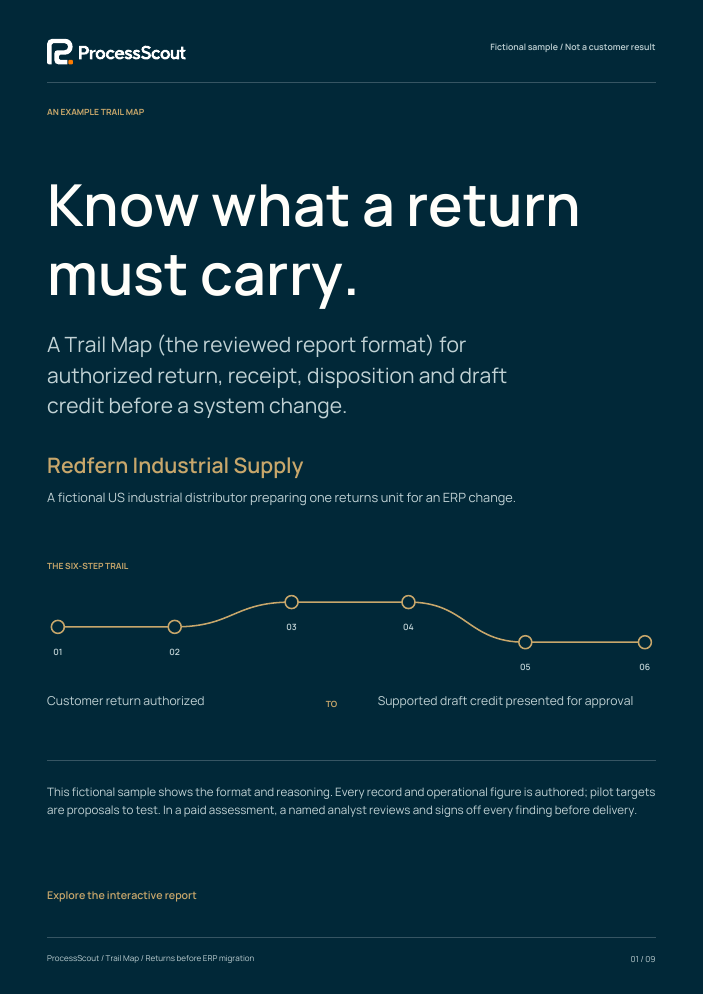
This fictional sample shows the format and reasoning. Every record and operational figure is authored; pilot targets are proposals to test. In a paid assessment, a named analyst reviews and signs off every finding before delivery.
01 / THE DECISION
Redfern’s returns carry inconsistent item codes, incomplete disposition decisions and approval evidence outside the credit record. A new system will still need those decisions. Define the meaning and approval trail before treating the migration as a field-transfer exercise.
Pilot a return-field mapping and disposition gate in the existing workflow. Reconcile draft credit evidence before approving requirements for the new ERP.
Four authored working weeks; 50 returns that reached supported draft readiness. At first draft review, 12 have inconsistent item or unit codes, 7 lack recorded disposition and 9 lack an approval link. These historical gap flags overlap; they are not the final readiness state. Timing uses an authored eight-hour weekday clock.
02 / THE CONNECTED WORKFLOW
In ProcessScout, the map is drafted from the sources and every step cites where it came from.

Use tested SKU and unit rules; stop on unknown conversions.
System: Approved mappingE02 ↗Decide stock treatment; some decisions are not retained on the case.
System: Notes + emailE04 ↗Check the draft against source and authority before issuance.
System: Review queueE05 ↗Reconcile the supported draft before authorizing any issued credit.
System: Approval queueE05 ↗Select any step to inspect the owner, system, evidence and proposed response. The target is a design hypothesis, not an implemented process.
03 / THE BASELINE
Elapsed time from recorded return receipt to a supported draft credit ready for approval.
400 business hours / 50 draft-ready return cases = 8 hours.E01 ↗Includes waiting; excludes returns still awaiting draft readiness, customer transit and final credit approval.Cases with unreconciled item or unit codes at first draft review.
12 mapping exception flags among 50 return IDs.E02 ↗Authored example; compare the same cohort definition in a real pilot.Cases lacking the retained stock-treatment decision at first draft review.
7 missing disposition records among 50 returns.E04 ↗Authored example; compare the same cohort definition in a real pilot.Cases with approval in email but no link from the credit at first draft review.
9 disconnected approval records among 50 returns.E05 ↗Authored example; compare the same cohort definition in a real pilot.04 / THREE OPPORTUNITIES
Options sit side by side with their costs, benefits and assumptions, so the choice can be challenged.

01 / Reconcile the data · Effort: Medium; mapping and test cases
At first draft review, twelve of fifty returns have inconsistent SKU or unit codes. A migration could copy the fields while preserving an unresolved difference in meaning.
E01 ↗E02 ↗E03 ↗Define approved SKU equivalences and unit conversions with source evidence, effective dates and an owner. Reconcile representative quantities and values in a test set. Treat unknown or conflicting conversions as an explicit hold.
Some differences may be valid packaging conversions. Preserve their approved meaning instead of forcing the same code everywhere.
02 / Keep stock treatment explicit · Effort: Low; decision checklist and owner
At first draft review, seven returns lack a recorded disposition. A received quantity alone does not tell finance whether the stock-treatment decision is ready.
E03 ↗E04 ↗E05 ↗Record inspection evidence, proposed disposition, reviewer and approval on the return case. Separate stock treatment from the credit decision. Name who resolves missing evidence and keep the case waiting until the required authority is present.
A disposition may exist in a warehouse record. Link the authoritative decision before adding a second approval step.
03 / Support the credit review · Effort: Medium; evidence links and review
At first draft review, nine cases have credit authority in email but no link on the draft record. The reviewer must reconstruct which decision supports which version.
E01 ↗E03 ↗E05 ↗Attach the authorized credit evidence to the draft, along with the original sale, receipt, item mapping and disposition. Reconcile the scope and amount to that authority. Specify these links as migration requirements before approving a target design.
Email may be the accepted authorization source. The problem may be stable linkage and versioning rather than the channel itself.
05 / THE 90-DAY PLAN
The chosen option becomes waves of work with owners, still linked to the original finding.

Data owner + returns lead
Mappings reconcile meaning, quantity and value.
Returns supervisor + controller
No draft bypasses required stock or financial authority.
ERP sponsor + process owner
Approve only requirements with traceable evidence and acceptance tests.
Indicative sequence. Timing depends on evidence readiness, access, owners and approvals. Production implementation requires a separate scope.
06 / THE SOURCE REGISTER
Recordings, documents and spreadsheets sit in one place, and each finding links back to its source.

The same evidence, reasoning and next step in a nine-page PDF.
Inspect the authored record rows and report schema behind this example.
Download structured sample data (JSON) ↓PROCESSSCOUT EDGE / GUIDED ASSESSMENT
Edge is ProcessScout’s guided assessment service for one recurring workflow.
$1,500 USD paid upfront
One legal entity, one business unit and one workflow.
A Trail Map (the reviewed report you receive), three prioritized opportunities, a baseline and a sequenced 90-day plan.
One supported starter asset: an SOP, control checklist, requirements specification or automation blueprint. Production implementation is a separate engagement.
The clock starts when sources, recordings, documents, interview and blocking questions are complete. Payment alone does not start it.

David Bell ↗ProcessScout review lead
25 years in operations and finance, including Shell and Deutsche Bank; founder and CEO of JustPayroll through its 2024 acquisition.
David Bell leads the review approach. The analyst assigned to your assessment owns its recommendations and sign-off.
If ProcessScout cannot identify at least three evidence-backed opportunities from a good-faith intake, the assessment fee is refunded under the assessment terms. This is a deliverable guarantee, not a promise of realized savings.
Read the assessment terms ↗Cancel before analyst review starts for a full refund. If the report materially misses the agreed brief, tell us within 14 days of full access and choose an in-scope correction or a refund after review.
Read the full protection policy ↗Bring one workflow and the decision you need to make.
The call scopes fit; it is not the assessment itself.
Allow optional analytics to help us improve ProcessScout? Privacy notice