

A finding becomes useful when another person can inspect how you reached it. That means keeping the original source, the particular passage or record, and the interpretation close together. It also means making uncertainty visible before the finding becomes a business case. Start with one decision you need to make, then collect enough evidence to examine it.
Start with a question that can change a decision.
“Improve onboarding” is a broad ambition. “Where do completed sales handoffs wait before delivery accepts them?” is an investigation. Define the process boundary, the period you will examine and what counts as a completed case. Write down what a useful answer would let the team do differently.
Keep an initial hypothesis if you have one, but label it. A manager’s belief that a queue is understaffed is a place to begin. It is not evidence that adding a person is the right intervention. Include a plausible alternative explanation in the investigation brief.
Preserve the source and its context.
For each source, record where it came from, who supplied it, when it was created and the period it describes. A current procedure and a two-year-old interview can both be useful, but they answer different questions. Save a stable version where your access and retention rules permit it.
Capture a precise reference: a page, paragraph, row, cell or recording moment. Avoid copying a sentence into a slide and losing the surrounding qualification. The person reviewing a finding should be able to reach the evidence without asking the original analyst to reconstruct the trail.
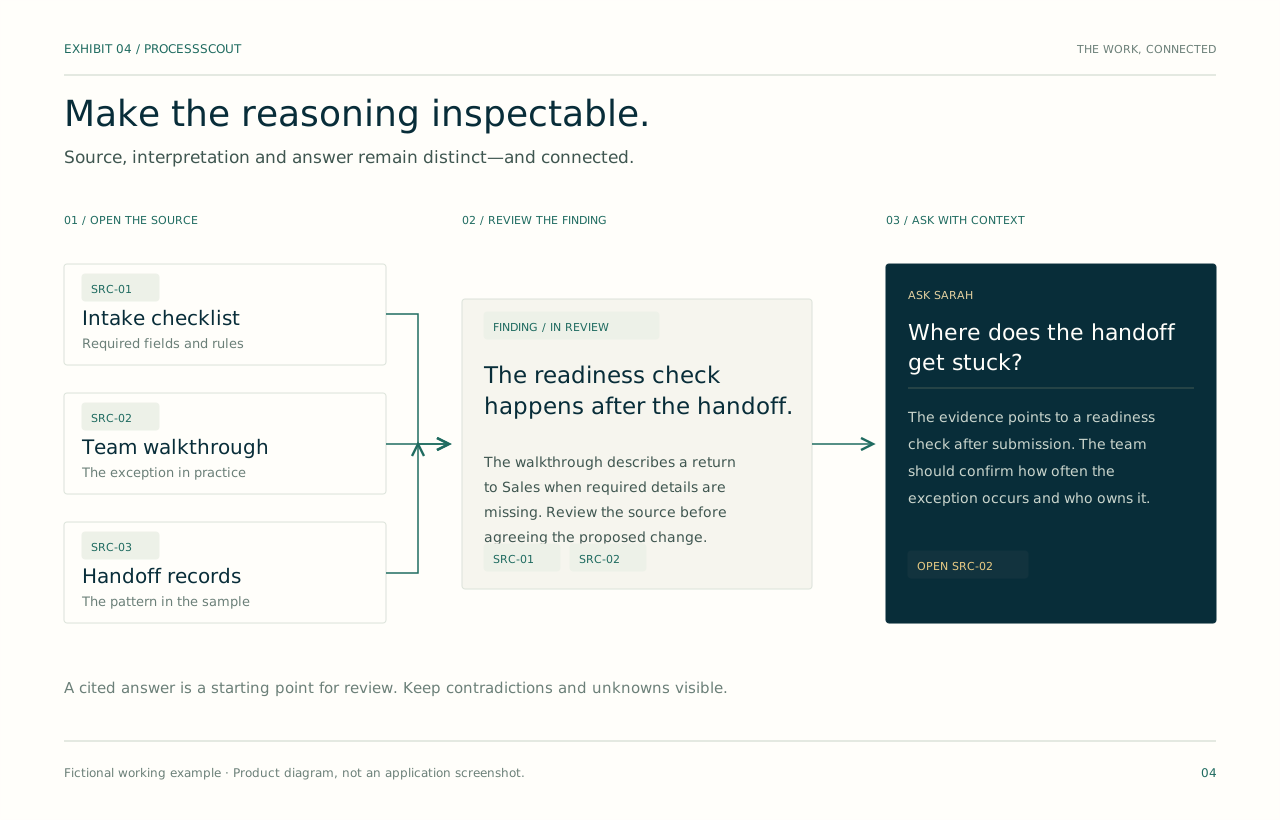
Separate observation from interpretation.
An observation reports what the source shows. An interpretation proposes what it means. A recommendation proposes an action. Keep those three statements separate. “Eight sampled cases returned for missing information” can be supported by records. “The intake form causes rework” needs further investigation.
Use an explicit state such as observed, reported, inferred or unresolved. Confidence should describe the basis for a statement, not simply how strongly its author feels. Look for independent corroboration and preserve contradictory accounts instead of smoothing them into a confident average.
Make review a specific task.
Ask the process owner to confirm the boundary, an operator to test whether the interpretation reflects normal work, and an analyst to check the calculations. A general “please review” often produces superficial approval. Give each reviewer a small set of claims and the sources needed to assess them.
When a reviewer disagrees, record whether the problem is factual accuracy, an incomplete sample, outdated context or a different interpretation. Update the finding rather than silently replacing its wording. Keep the unanswered question and the next evidence-gathering action beside it.

Fictional working example
A finding with a useful boundary
Northstar reviews 40 handoffs from one service team over four weeks. Eight have a recorded return for missing scope. The finding says “20% of this sample returned for missing scope,” names the source rows and identifies the team and period. It does not say that 20% of every handoff in the company fails. The proposed next step is to compare the intake fields with the information delivery actually requires.
- Observation
- 8 of 40 sampled cases returned
- Interpretation
- Required information may be unclear
- Next evidence
- Compare intake fields and return reasons
Bring this to the review
A practical checklist.
- The finding has an exact source reference.
- Its scope, period and sample are visible.
- Observed facts and interpretation are separate.
- Conflicting evidence and missing information remain visible.
- A person owns the next review or evidence request.
In ProcessScout
In ProcessScout, sources, findings and contextual Ask Sarah answers help keep the evidence within reach. Open the citations and review the interpretation before approving a consequential change. A fluent answer does not replace that review.