

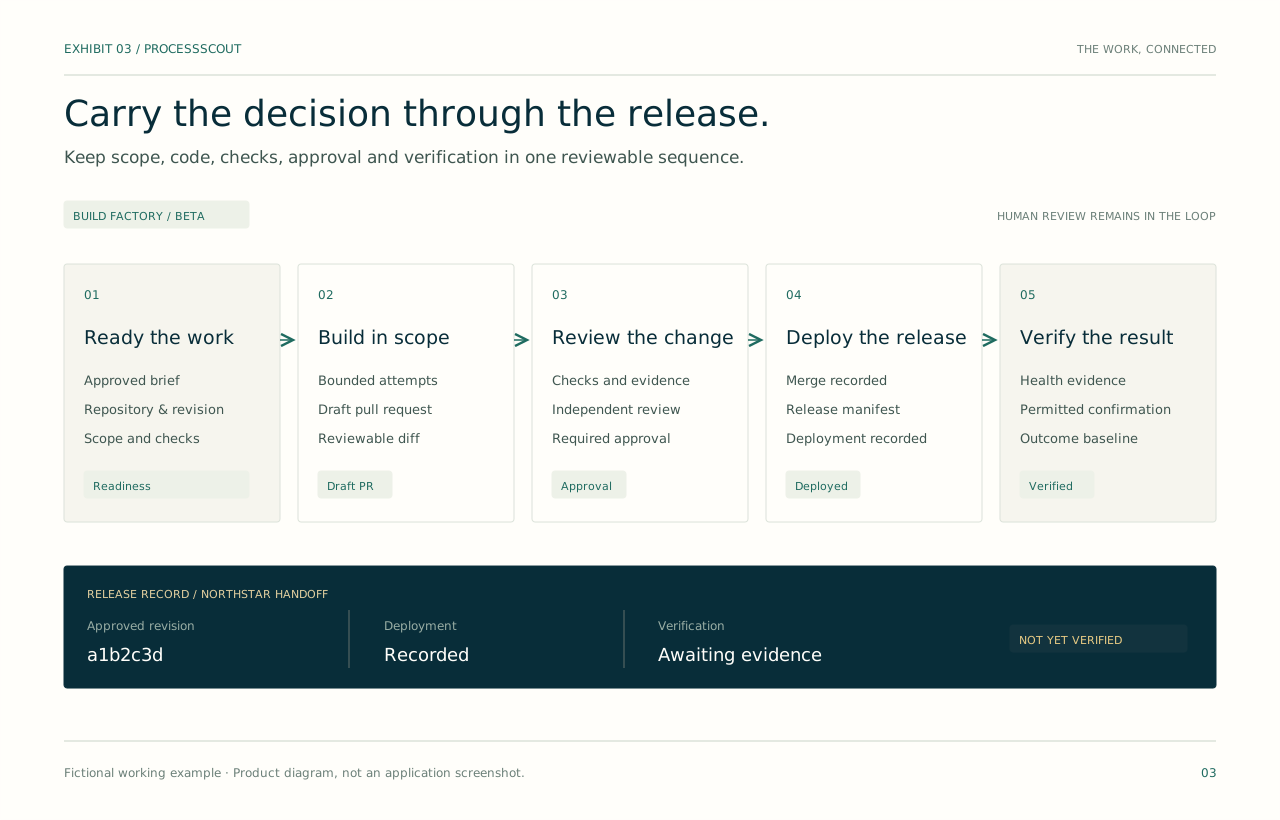
A change can be merged without being deployed, deployed without being healthy, and healthy without being used. It can also be used without producing the expected business result. Those are different questions. Give each one a visible state, a responsible person and appropriate evidence rather than treating launch as the end of the work.
Define what each delivery state means.
Agree the evidence required for implementation complete, deployed and verified. A pull request merged into a branch does not establish that users have the change. A successful deployment does not establish that the relevant user journey works. Record the environment and revision so evidence refers to a specific release.
Choose meaningful health checks and identify who can confirm release verification. Keep failures and unresolved observations visible. If the change needs to be reversed, use the agreed rollback or revert process and preserve the reason. Avoid overwriting the delivery history with a single green status.
Keep the baseline with the measure.
For each intended outcome, define the metric, unit, population, source and sampling period. Preserve the baseline before the change takes effect where possible. If no defensible baseline exists, state that clearly and establish one; a target alone cannot show improvement.
Name a measure owner who can obtain comparable readings. Confirm that the definition will remain consistent after the process changes. If a new system records timestamps differently, document the difference before presenting a trend. Apparent improvement can come from a changed measurement boundary.
Measure whether the new behavior is happening.
Track the practical adoption condition. That could be the share of eligible requests using the new route, completion of an agreed review or retirement of a parallel spreadsheet. Attendance at training is useful context, but it is not the same as use in day-to-day work.
Ask operators what still makes the old route necessary. A workaround can reveal missing functionality, an unclear rule or a transition problem. Keep those findings connected to delivery actions and distinguish temporary rollout effects from persistent problems in the design.
Review outcomes on an agreed cadence.
Choose review windows that fit the volume and latency of the process. Early checks may focus on health and adoption; later reviews can examine operational outcomes. Compare actual readings with the baseline and target, and explain changes in demand, staffing or case mix that could affect the result.
Decide what to do with the evidence. Continue, adjust, investigate or reverse the change as appropriate. Record the decision and the next owner. A result that falls short is still useful when it improves the next action; hiding missing measures only removes that opportunity to learn.

Fictional working example
A healthy release with incomplete adoption
Northstar deploys a revised handoff form and verifies that valid requests reach the queue. The first review finds that one team still emails requests because its required attachment is not supported. The release is technically healthy, but adoption is incomplete. The team adds the attachment requirement to the backlog and avoids claiming the full forecast benefit before the new route is consistently used.
- Release verification
- Valid requests reach the queue
- Adoption gap
- One team still uses email
- Next action
- Resolve the attachment requirement
Bring this to the review
A practical checklist.
- Merged, deployed and verified are distinct states.
- Release evidence identifies an environment and revision.
- Each outcome has a baseline, definition and owner.
- Adoption is measured in operational behavior.
- Review findings lead to an explicit next decision.
In ProcessScout
ProcessScout connects delivery and value records to the earlier decision. Build release records distinguish deployment from verification, while linked measures can carry baseline and later actuals. Missing measurements remain visible so a completed release is not mistaken for a proven business outcome.