

An improvement can release useful time without reducing expenditure. That time may support more work, shorter queues, better service or less overtime. Calling every released hour a cash saving makes the business case harder to trust. Describe the operational change first, then identify how the organization expects to use the capacity.
Measure the right kind of time.
Separate active effort from elapsed time. A case can spend two days waiting while requiring only twenty minutes of work. Reducing the wait may improve service, but multiplying two days by an hourly rate would overstate labor capacity. Define the measure and examine representative cases.
Record annual volume and the population to which the change applies. If only one type of request benefits, use that volume. Account for adoption and for work that moves to another role. A step disappearing from one team’s screen does not mean its effort has disappeared from the organization.
Make the capacity calculation inspectable.
A simple capacity estimate multiplies eligible volume by adoption and net time released per case. Convert minutes to hours explicitly. If you attach a loaded hourly rate, label the result as the value of released capacity. Keep implementation cost and ongoing operating cost visible as separate inputs.
Use ranges or sensitivity cases for uncertain inputs. Avoid assuming full adoption immediately after launch. If the work has seasonal peaks or a learning period, reflect that in the plan. A first-year estimate should not silently use a full year of steady-state benefit when implementation occupies part of the year.
Name the mechanism for a cash effect.
A cash benefit needs an operational mechanism, an accountable owner and a timing assumption. Examples could include reduced paid overtime, avoided external spend or a planned reduction in a specific cost. Validate the mechanism with the relevant owner before describing it as a saving.
Keep service and risk outcomes separate as well. Faster response, fewer returns and stronger controls can matter even when their financial effect is uncertain. State how each will be measured. This preserves useful benefits without forcing every outcome into a monetary value that the evidence cannot support.
Plan how the capacity will be used.
Ask what the team will do with the released time and what might prevent that. Small fragments of time spread across many people may not translate into a usable block of capacity. Rebalancing work, changing schedules or retiring parallel tasks may be necessary to realize the intended outcome.
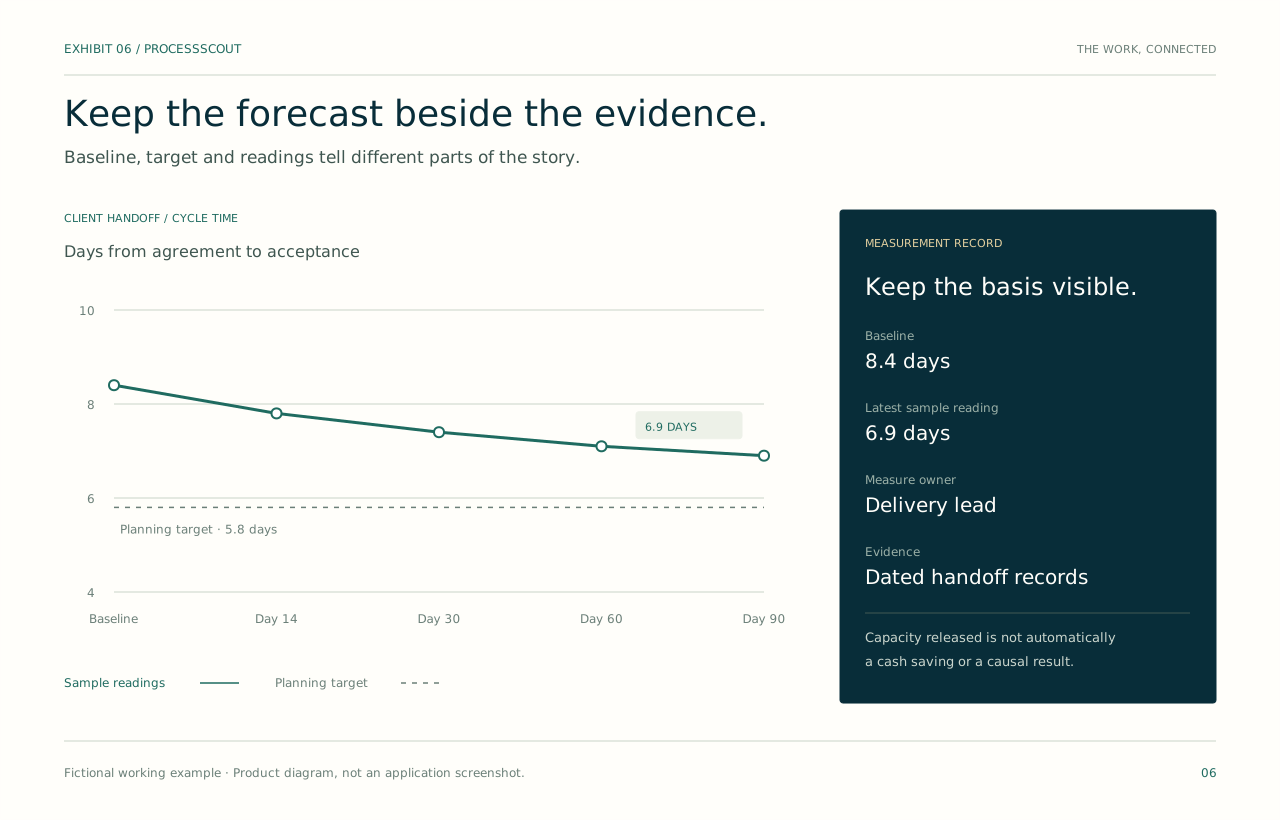
After launch, compare observed effort, adoption and volume with the forecast. Retain the baseline and explain changes in demand or staffing. Record capacity released, cash effects and service outcomes independently. The business case should become a measurement plan, with a clear explanation when the expected result does not appear.

Your inputs · a method, not a result
Write the method before the number
Write the estimate as a formula your reviewers can fill in with their own reviewed inputs. V is the eligible volume in the period: only the cases the change applies to. A is the share of those cases expected to follow the new route. t is the net effort released per adopted case, in hours, after any work that moves to another role. Capacity released is V × A × t. Multiplying by a loaded hourly rate r gives capacity value: what the time is worth if it is used. It is not a cash saving until someone names how expenditure will change.
Fictional illustration, not a result: Northstar’s reviewers take V from a year of intake records, start A at a cautious pilot share and time a sample of cases to set t, net of the new checklist step. They record the total beside its inputs, and leave the cash line empty until Finance names a mechanism.
- Capacity released
- V × A × t hours in the period
- Capacity value
- V × A × t × r, which is not cash
- Cash effect
- Only with a named mechanism, owner and timing
Bring this to the review
A practical checklist.
- Effort and elapsed time are distinguished.
- Eligible volume and adoption are explicit.
- Transferred work and operating cost are included.
- Cash effects have a specific realization mechanism.
- The owner has a plan for measuring and using capacity.
In ProcessScout
ProcessScout carries assumptions from the decision into value tracking so a forecast remains distinguishable from later readings. The demo’s financial figures are fictional capacity estimates. Use reviewed measures and the appropriate owners to establish a real business case.