

A critical workbook is often a business system in disguise. Its formulas encode rules, its tabs coordinate a workflow and its exceptions record decisions that never reached a formal specification. Replacing it without understanding those details can remove essential behavior. Start by learning what the workbook does and who depends on it.
Establish purpose, ownership and a stable copy.
Ask what decision or operational task the workbook supports, who maintains it and who uses its outputs. Record the cadence and the cost of a wrong or late result. A planning model used quarterly needs a different review from a file that drives daily payments or schedules.
Work from an authorized copy and record its version, saved date and calculation context. Preserve the original. Identify external links, add-ins and macros before interpreting the contents. A saved value can be useful evidence while still depending on a calculation or external refresh you have not reproduced.
Trace a consequential output backwards.
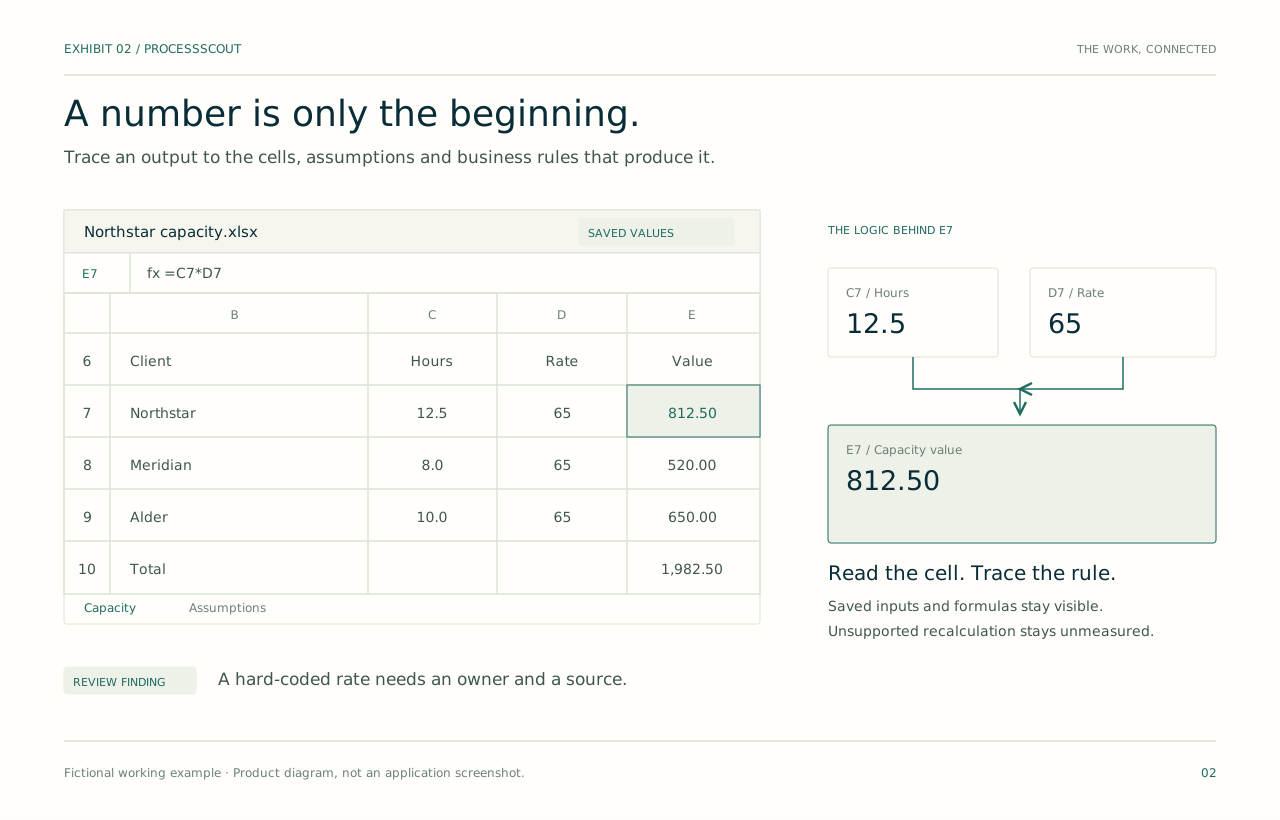
Choose a number that someone actually uses. Follow its formula to upstream cells, input tables and external references. Explain the rule in plain language and ask the owner whether that explanation matches the intended policy. Note where a fixed value overrides a formula or an assumption changes by row.
Look for repeated formula patterns and the cells that break them. An exception may be an error, an intentional adjustment or a temporary workaround that became permanent. Keep the cell reference and the owner’s explanation together rather than automatically classifying every unusual cell as a defect.
Inspect the controls around the calculation.
Check how inputs arrive, what validation happens and who can change the rules. Look for broken references, hard-coded numbers inside formulas, cached errors, volatile functions and missing review steps. Prioritize findings by the decision they affect, not by the number of warnings an analysis produces.
Reconcile a small set of meaningful outputs against an agreed source. State whether you checked saved values, recalculated formulas or independently reproduced the logic. These are different levels of assurance. If the calculation path cannot be verified, retain that uncertainty in the review.
Choose a path for the business function.
Consider keeping a well-controlled workbook, improving its controls, absorbing the function into an existing system, automating a repeated handoff or retiring an unused output. The answer need not be a new application. Describe the business rules and interfaces that any replacement must preserve.
Before migration, agree acceptance examples with the workbook owner. Include typical cases, boundary conditions and known exceptions. Retain a comparison period where appropriate and name the person who can approve retirement. A new screen is not evidence that the old function has been reproduced.

Fictional working example
A formula exception with a business reason
Northstar’s capacity workbook calculates hours from job volume and a standard effort rate. One row contains a fixed total. The owner explains that the client has a contractual minimum. The finding becomes a documented business rule with a cell citation and an acceptance example. A replacement proposal must support the minimum explicitly instead of copying the unexplained constant.
- Inspect
- Output cell and its upstream inputs
- Explain
- Contractual minimum overrides the standard rate
- Preserve
- Rule, evidence and acceptance example
Bring this to the review
A practical checklist.
- The business purpose and owner are named.
- The reviewed version and saved-value basis are recorded.
- Important outputs have a traced calculation path.
- Exceptions have been reviewed with an informed person.
- Any replacement has agreed acceptance examples.
In ProcessScout
Spreadsheet Expert brings the grid, formula logic, issues and system view together. Ordinary reads use saved values; macros are not executed. What-if results require a supported calculation path that reproduces the saved results. Unsupported or unverifiable results remain unmeasured.