

A connected model helps a team see beyond the part of the business it knows best. A process change may touch a system, a control, a team and a measure owned elsewhere. The value of a Digital Twin comes from making those relationships inspectable. Its usefulness depends on the records, links and evidence represented in the model.
Begin with the change you are considering.
State the proposed change in operational terms. “Introduce a readiness check before scheduling” is more useful than “transform onboarding.” Name the process and the outcomes you expect to influence. Set the boundary of the review so you can distinguish modeled impacts from areas that still need discovery.
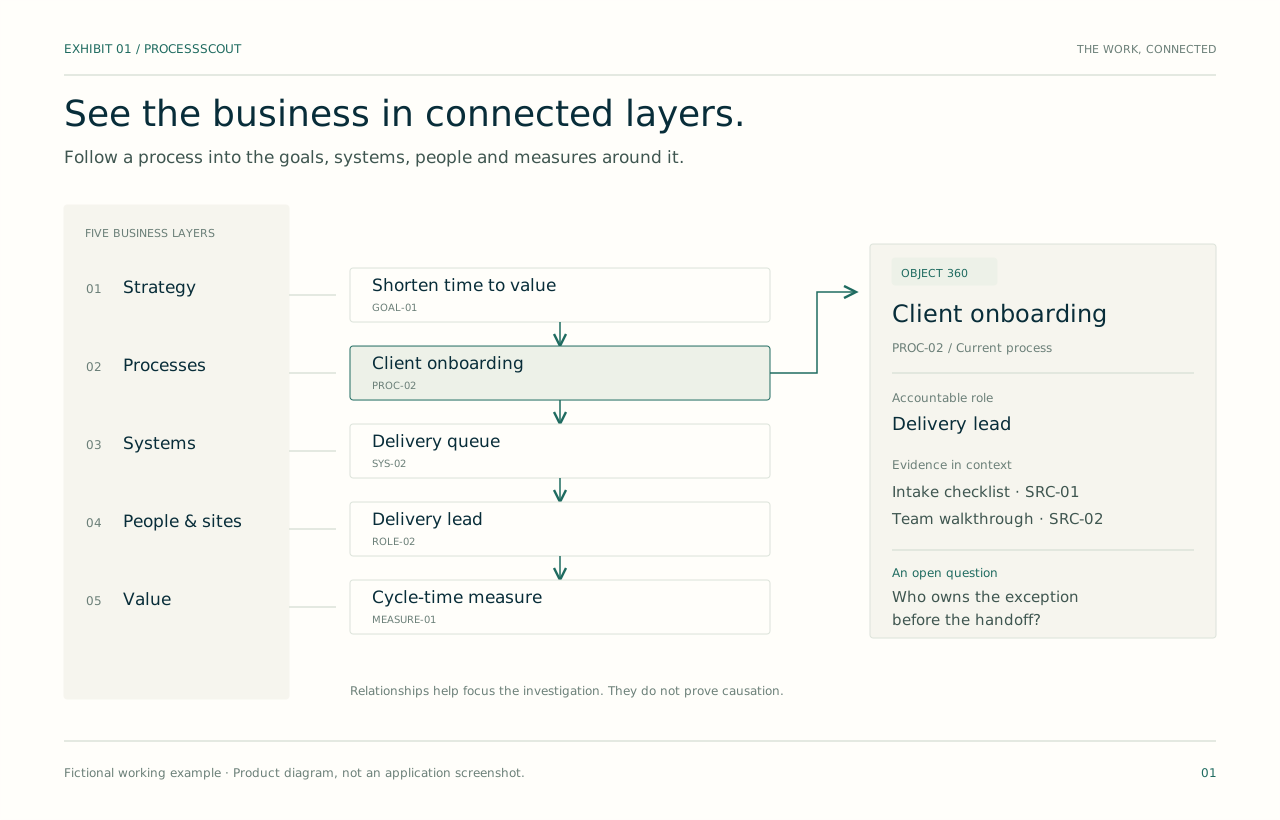
Orient the discussion across five layers: strategy, processes, systems, people and sites, and value. Ask which records already exist and which are missing. An empty relationship is a question to investigate. It is not confirmation that no dependency exists.
Inspect the objects and the links.
Open the important process, system, goal or problem and review its properties, provenance and relationships. Check whether the relationship reflects an observed dependency, an owner’s account or an analyst’s inference. The distinction matters when the model will support a consequential decision.
Trace a path between the proposed change and the expected outcome. Identify the weakest link: the assumption with the least support or the record that may be outdated. A plausible chain on a diagram is a useful explanation to examine, but it does not establish real-world causation.
Look for collisions and unanswered questions.
Explore immediate effects and the next layer of dependencies. Who will receive different information? Which system behavior must change? Does another project already plan to modify the same step? Include operational owners in the review because an apparently small change can create a large training or coordination burden.
Compare scenarios using the evidence and ranges available. Keep missing bounds unknown rather than filling them with precise-looking estimates. Write down what would invalidate the preferred scenario. This turns an impact review into a plan for resolving uncertainty, instead of a presentation that merely supports a favored option.
Save a view that supports a real decision.
An executive review needs the current situation, the most important problems, the options, the decision required and the basis for expected value. An analyst investigation needs deeper paths, references and open questions. Use the same underlying context while changing the level of detail for the audience.
Save the objects, paths and findings that explain the recommendation. Record the assumptions and the date of the review. When the underlying evidence changes, revisit the decision. Treat the model as a maintained aid to judgment rather than a complete, automatic replica of the business.

Fictional working example
An operational change reaches beyond its process
Northstar proposes a readiness check for client handoffs. The model connects the check to Sales, Delivery, the request queue and a scheduling measure. A second initiative also plans to change the request form. The team combines the form work, assigns one owner and leaves the effect on scheduling time as an assumption to test. The model reveals a coordination question; it does not prove the forecast.
- Process
- Client handoff readiness
- Collision
- Two initiatives change the same form
- Unknown
- Effect on scheduling time
Bring this to the review
A practical checklist.
- The proposed change and review boundary are explicit.
- Important objects have provenance and an owner.
- Weak or missing relationships are visible.
- Impacts include people and competing initiatives.
- A saved view explains the decision and its assumptions.
In ProcessScout
ProcessScout’s Digital Twin connects authorized project records across five layers. Object views, scenario exploration, executive summaries and saved boards support different levels of investigation. Use the evidence and access available to the current viewer, then send a decision forward for human approval.