01
Focus on useful work
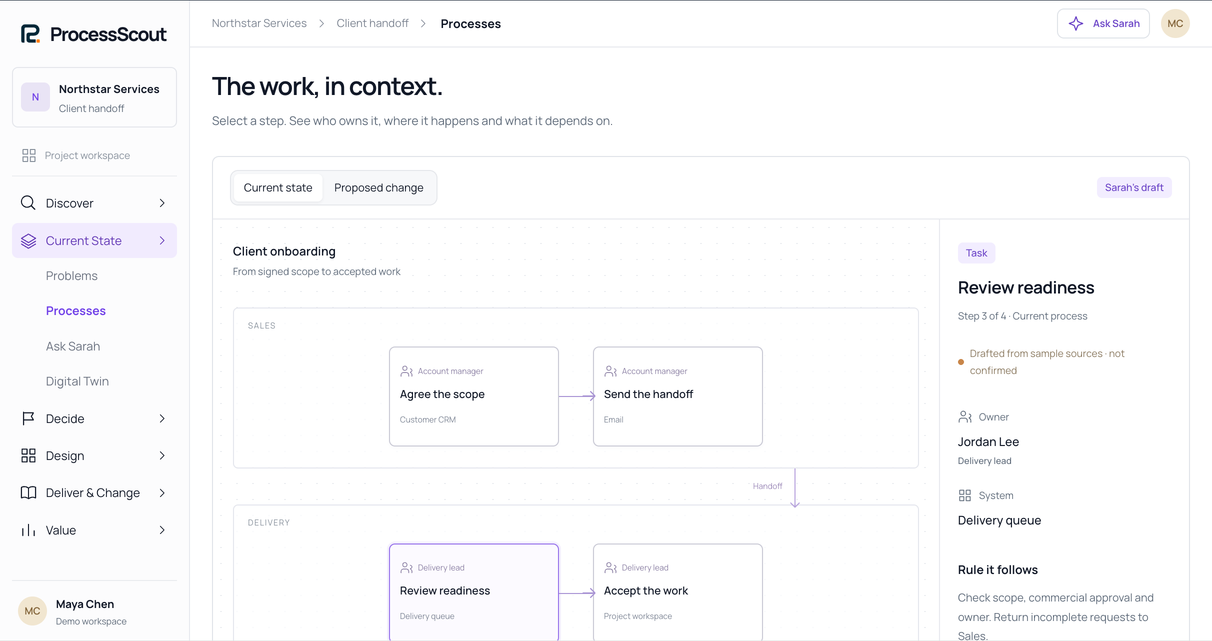
Tie the agent’s proposed role to a specific job in the customer’s operation.

Turn the promise of your agent into an agreed customer workflow. Define the job, information, actions and human decisions before engineering configures, evaluates and deploys it.
Explore the example. See the decisions behind the delivery.
Tie the agent’s proposed role to a specific job in the customer’s operation.
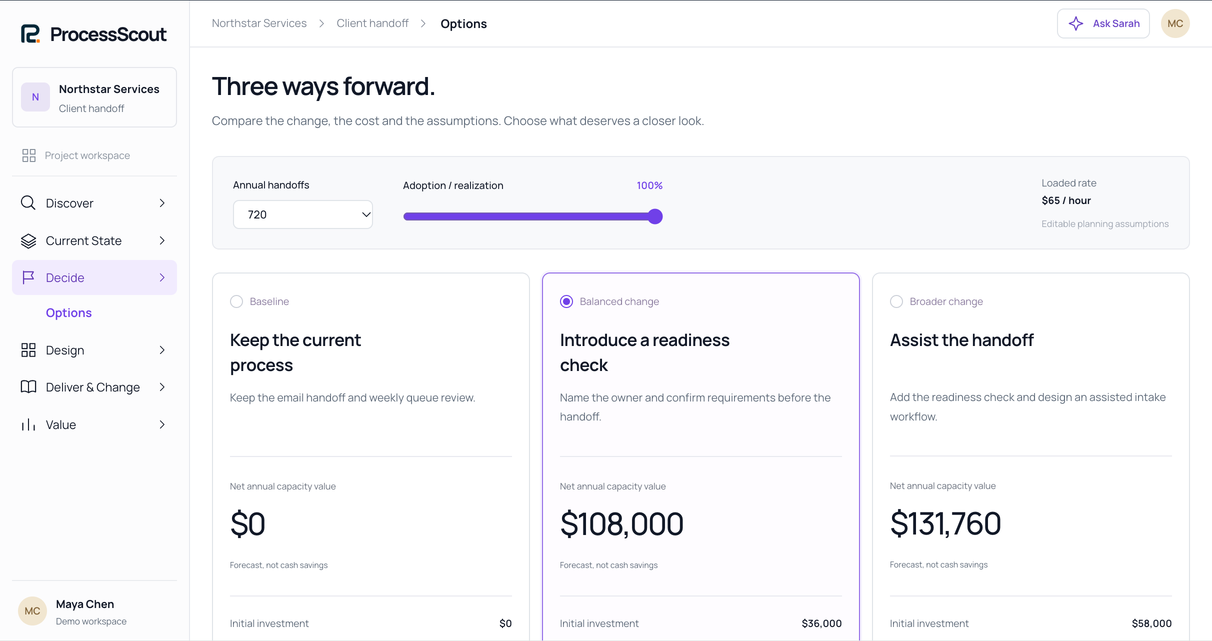
Agree approval rights, exception routes and escalation ownership before live operation begins.
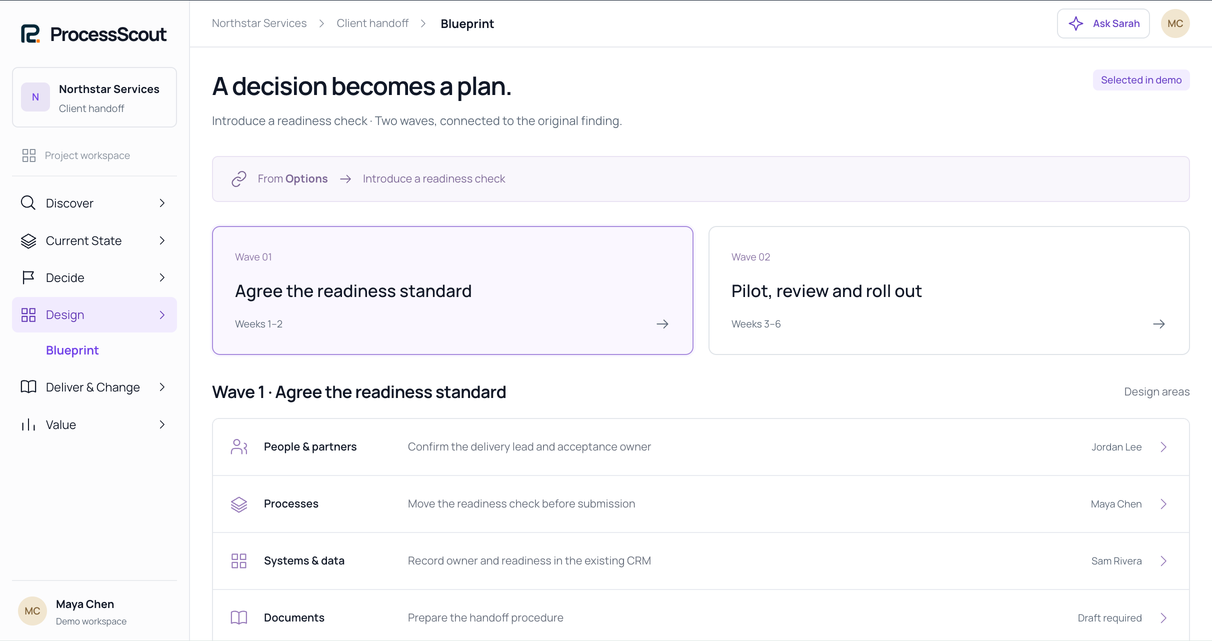
Carry reviewed rules and acceptance cases into implementation, evaluation and production checks.
For agent teams
Map the work, choose where an agent helps and keep people in the decisions that matter, in the product your team already reviews.


Interactive demo · Fictional customer data · No sign-up
In the Northstar example, a proposed assistant checks purchase-request fields and recommends an approval route. People approve or reject. Agree that division of work before implementation.
A purchase request supplies fields. The proposed assistant checks the request and prepares a route. A designated person makes the approval decision.
Proposed target after D-01 and D-02. The original walkthrough remains uncertain about finance approval.
Q-05 · Who receives an escalation, and through which route?
Owner: Customer process owner
Missing amounts require clarification; urgent orders require notification and approval. Conflicting sources need a customer decision. The assistant must neither guess values nor bypass approval.
Urgency does not bypass the required approval. If the amount is missing, the assistant asks for clarification and does not prepare a route. Conflicting sources need customer review, not a guessed rule.
Notify the purchasing manager. The amount-based approval still applies; urgency cannot authorize bypass or release.
Inspect urgent-request behaviorAsk the requester for clarification. Do not prepare an approval recommendation until a valid amount is supplied.
Inspect incomplete-request behaviorKeep the disagreement visible and ask the customer process owner to decide. A proposed assistant must not invent a resolution.
Inspect the question registerCheck amounts below, at and above $10,000, plus urgent and incomplete requests. Turn each into an acceptance case your evaluations can run.
Under the fictional reviewed target rule, USD 9,999 routes to the purchasing manager. USD 10,000 and USD 10,001 route to finance. These acceptance examples have not been executed.
Purchasing manager review
R-01 · Expected behaviorFinance review
R-01 · Expected behaviorFinance review
R-01 · Expected behaviorNotify purchasing manager; finance approval still required. No bypass or release.
R-02 · Expected behaviorRequest clarification; do not prepare an approval recommendation.
R-03 · Expected behaviorThese are expected behaviors for the fictional target. No model or implementation tests have been executed.
Document permitted reads and actions, required tools and human decisions. Include urgent and missing-information paths. Engineering must confirm architecture, permissions and runtime behavior during implementation.
The proposed assistant reads agreed context and prepares a recommendation. Purchase approval or rejection remains with a person. The diagram does not run an agent or enforce permissions.
Order ID · valid amount in USD · urgent status · reviewed routing rule
Proposed design for the customer implementation. Urgency never authorizes bypass. Identity and access (Q-04) and escalation (Q-05) remain open.
Run the agreed requirements through implementation evaluations and operational checks. Record what ran, the observed results and remaining decisions before reviewing readiness with the customer.
Take the expected cases into implementation checks, record actual results after execution, and have a person review the evidence before deciding on live delivery.
An exception may suggest a rule, integration or product change. Keep its customer evidence attached, then review scope and engineering work before changing agent behavior.
A customer request enters Product review. Agreed scope can inform development; later operating feedback returns with its customer context. The fictional CR-01 request is still pending.
The request extends the agreed brief. Production integration remains excluded until scope, architecture, access and effort are reviewed.
How a pilot works
SaaS vendors, agent providers and partners implementing agents inside customer businesses, whether agents extend the platform or are the product.
It prepares customer context, rules and acceptance cases. Your engineering team owns model evaluation, runtime behavior and production checks.
The vendor and customer review proposed permissions, risks and business decisions. The brief records boundaries; implementation must enforce them.
Keep the conflict visible and assign a reviewer. An unreviewed interpretation must not become the operating rule.
We’ll scope the workflow, rules and human responsibilities your engineering team needs to review.
Discuss a pilotScope, timing, access and terms are agreed before a pilot begins.
Allow optional analytics to help us improve ProcessScout? Privacy notice