01
Improve the deployment fit
Understand people, systems and constraints before choosing how your product should work.

Give consultants and implementation partners a clear view of the customer’s operation. Turn walkthroughs, policies and workbooks into a reviewed design your product and delivery teams can act on.
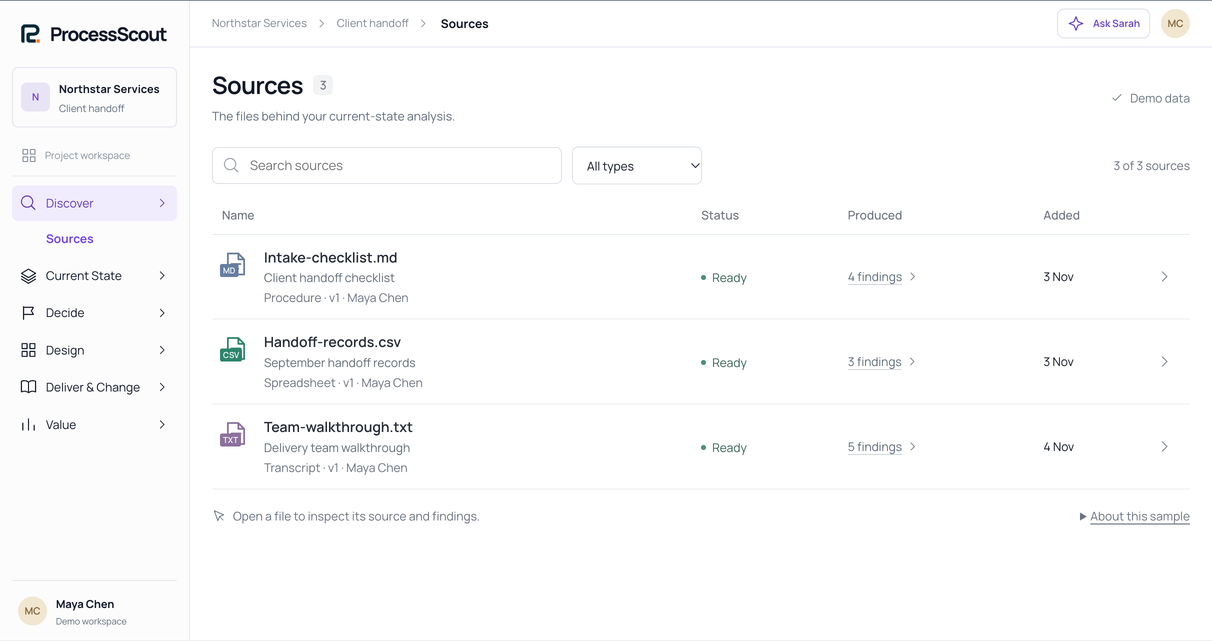
Explore the example. See the decisions behind the delivery.
Understand people, systems and constraints before choosing how your product should work.
Keep sources, decisions and open questions together for the next delivery owner.
Show Product the operating problem behind each requested feature or extension.
For discovery
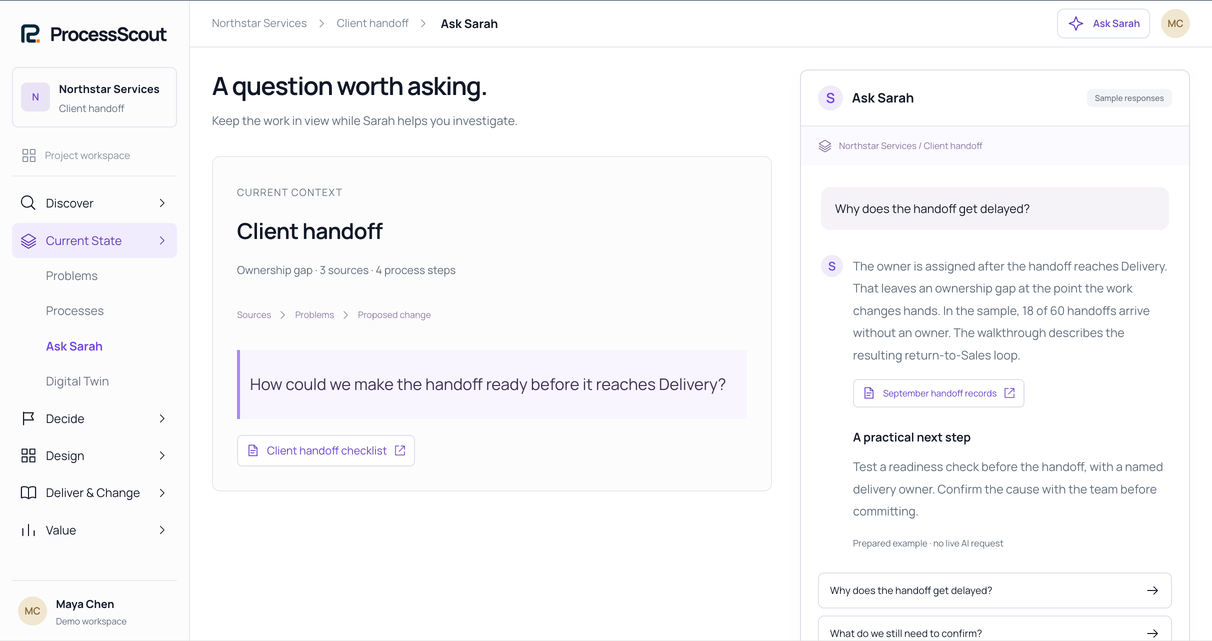
Turn what you hear and read at the customer into a cited, reviewable design, without another round of meetings.


Interactive demo · Fictional customer data · No sign-up
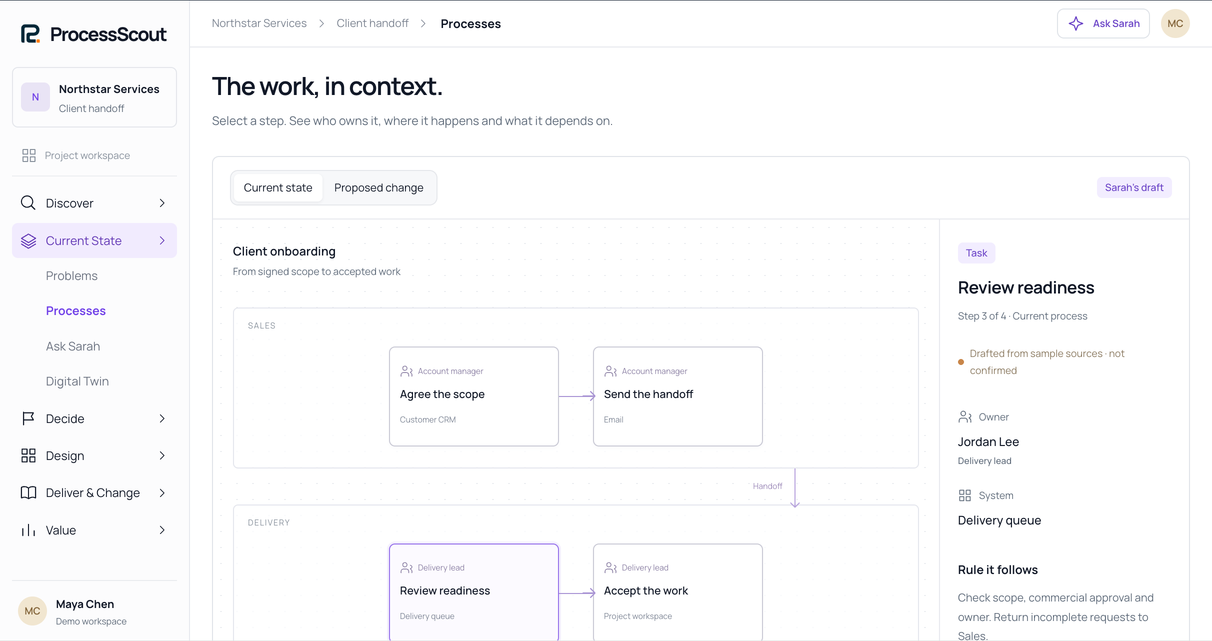
Map decision rights, handoffs, systems, data and controls. Keep sources and open questions visible so the design reflects the customer’s real constraints.
People, handoffs, systems, data, rules and exceptions surround the customer workflow. Each informs the deployment design.
Requester, purchasing manager and finance roles
POL-01REC-01Reporting lines and named owners to confirmPurchasing-manager notification and proposed approval routing
REC-01Escalation remains open under Q-05The approval workbook is supplied
WB-01ERP, messaging and identity systems to confirmThis register distinguishes supplied evidence from what still needs discovery. It is not a completed organization, architecture or data-flow model.
Exceptions show where people improvise. In the Northstar example, the requester knows whom to message for an urgent order, but not whether finance must still approve.
A policy, workbook and authored walkthrough inform the customer workflow. The sources are evidence for review; a walkthrough does not itself authorize an exception.
Urgent request: notify the purchasing manager. Approval before release is unclear.
Authored transcript excerptAt exactly USD 10,000, the policy and workbook disagree. Inspect the question.
Review the proposed workflow with the customer before shaping the solution. In the example, the customer confirms urgency never bypasses approval, and the original account stays on record.
Original evidence goes to customer review, where authored decisions D-01 through D-03 define the fictional proposed target. The source material remains available.
“Finance reviews orders above USD 10,000; an urgent request messages the purchasing manager.”
POL-01REC-01This draft does not settle the boundary or permission to release an urgent order.
“Use finance review at or above USD 10,000. Urgent requests still need the required approval; notifying the purchasing manager is an additional step.”
Customer process owner · fictional review
D-01 · threshold · D-02 · urgencyThis prepared review changes the proposed target behavior. The policy and walkthrough remain unchanged as supplied evidence.
Threshold, urgent and missing-amount behavior are settled. Identity access and escalation ownership stay visibly open, so engineering knows exactly what is still undecided.
The example defines the threshold and exception rules. Identity and access under Q-04 and escalation under Q-05 remain unresolved prerequisites for implementation.
For the proposed target workflow, purchase orders at or above USD 10,000 require finance approval. Lower amounts require purchasing-manager approval.
Reviewed in exampleAn urgent request notifies the purchasing manager, while the amount still determines the required approval route. Urgency does not authorize release or bypass approval.
Proposed designWhen the purchase amount is missing, request clarification from the requester. Do not prepare an approval recommendation until a valid amount is supplied.
Proposed designQ-04 · Which identities and access rights will support the workflow?
Owner: Customer process owner
Pass the sources, reviewed workflow, open questions and operating guide together. Give the receiving engineer a way to inspect decisions without repeating the discovery meeting.
Delivery passes the customer context, requirements and operating instructions to the customer operating owner. Q-04 and Q-05 travel with the packet and remain open.
Prepare the brief, preserve source references and carry open questions into implementation.
Confirm business behavior and acceptance; resolve Q-04 and Q-05 with the relevant specialists.
Confirm architecture, identity/access and implementation checks. Run implementation tests before a readiness decision.
Maintain the procedure and follow the agreed approval route after operational readiness is established.
Fictional role labels. Reviewed rule: R-01 · at or above USD 10,000 goes to finance.
Q-04 · Which identities and access rights will support the workflow?
Owner: Customer process owner
Show the affected workflow, users and systems. Product can then review whether the customer need belongs in configuration, an extension or a roadmap change.
A customer request enters Product review. Agreed scope can inform development; later operating feedback returns with its customer context. The fictional CR-01 request is still pending.
The request extends the agreed brief. Production integration remains excluded until scope, architecture, access and effort are reviewed.
How a pilot works
The brief links statements to sources and decisions. Evaluate total preparation, review and handover effort, including questions the receiving engineer still asks.
Supported recordings can inform a draft. An engineer or customer process owner reviews the instructions, exceptions and responsibilities before use.
Yes. Agree workspace access, source permissions and review responsibilities before sharing customer material with a partner.
Bring one process. We’ll scope the discovery, customer review and design decisions your delivery team needs.
Discuss a pilotScope, timing, access and terms are agreed before a pilot begins.
Allow optional analytics to help us improve ProcessScout? Privacy notice