01
Make delivery commitments clear
Keep included work, exclusions and unresolved dependencies visible in one shared brief.

Give deployment leaders a clear basis for commitments. Agree the customer outcome, product fit, dependencies and ownership before your team estimates or expands the work.
Explore the example. See the decisions behind the delivery.
Keep included work, exclusions and unresolved dependencies visible in one shared brief.
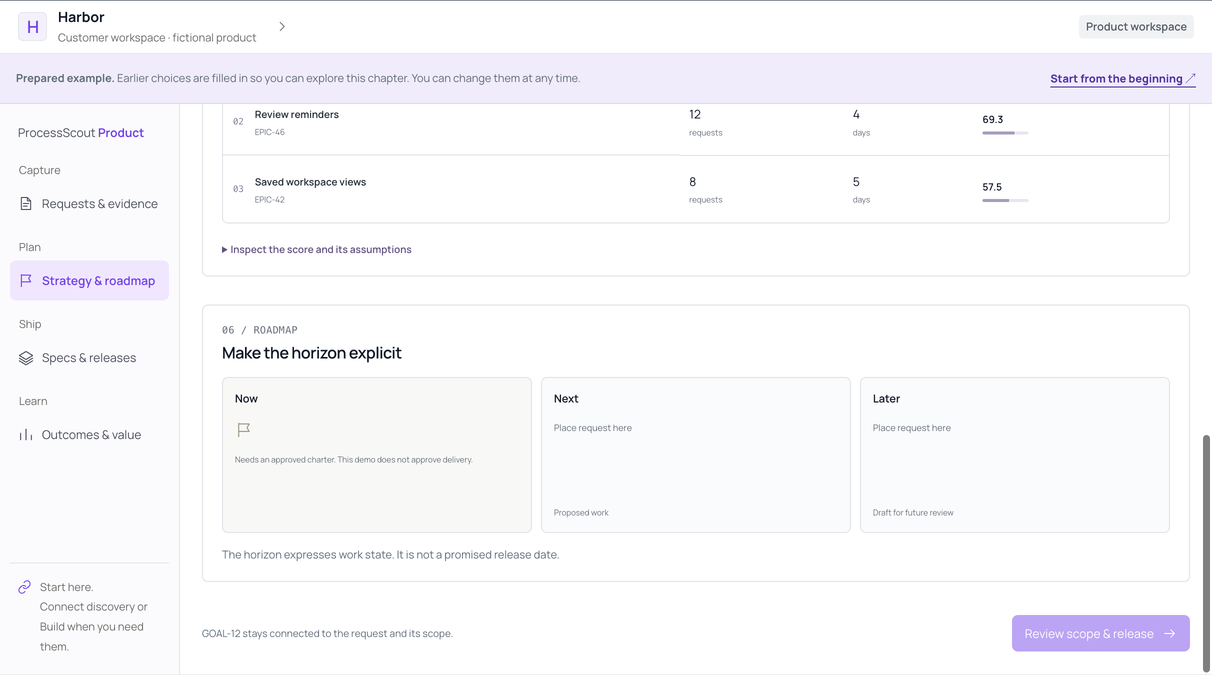
Review new requests against product priorities and engineering needs before expanding scope.
Agree measures, owners and review periods before interpreting the customer’s results.
For delivery leads
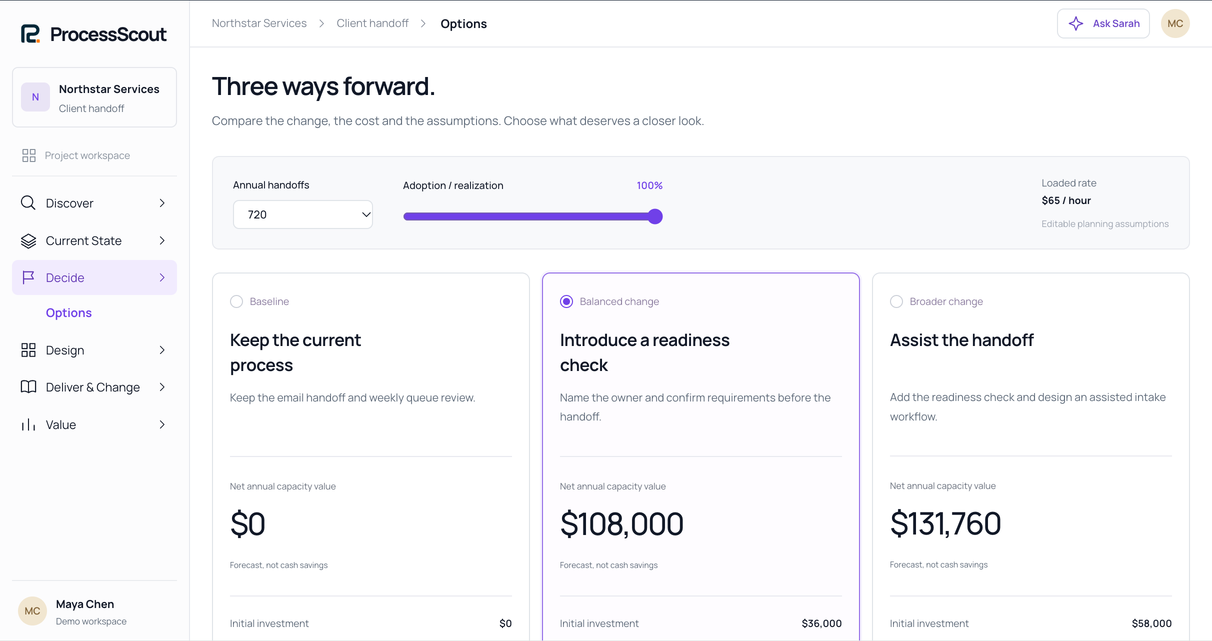
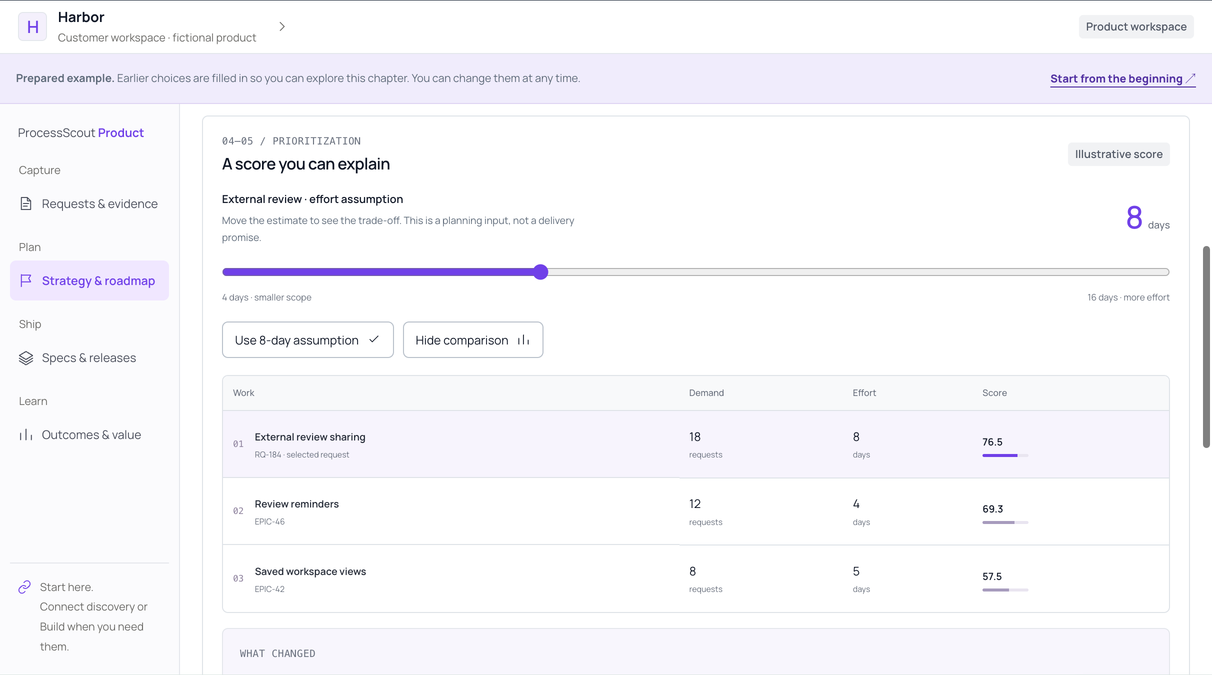
Compare options, weigh priorities and agree the measure, with the customer evidence one click away.


Interactive demo · Fictional customer data · No sign-up
Review standard configuration, integration needs and human or agent roles against the customer workflow. Keep the proposed design grounded in your product’s current capabilities.
Customer workflow informs product fit. Product and delivery review standard configuration, an extension, or a product change; no choice is approved by this diagram.
Purchase requests, approval rules and urgent exceptions
Procedure · operating owner · escalation route
Inspect the handoverProposed use of a vendor’s product, subject to capability and implementation review. Access and escalation remain open.
Northstar needs a clear purchase-approval route, but its policy and workbook disagree at exactly $10,000. Resolve boundaries like this before estimating. They decide the build.
At exactly USD 10,000, original policy POL-01 uses greater than and selects purchasing-manager review. Workbook WB-01 uses greater than or equal to and selects finance review. The original sources remain different.
=IF(B2>=10000,"Finance review","Purchasing manager review")This formula refers to B2 in the same workbook version. Open the complete WB-01 excerpt.
Include the routing brief, requirements, acceptance cases and operating instructions. Exclude payment execution, ERP replacement and production integration. Keep every dependency visible.
The agreed fictional brief covers workflow, rules and handover. Production integration sits outside that boundary; the detailed example also excludes payment execution and ERP replacement.
For the proposed target workflow, purchase orders at or above USD 10,000 require finance approval. Lower amounts require purchasing-manager approval.
Reviewed in exampleAn urgent request notifies the purchasing manager, while the amount still determines the required approval route. Urgency does not authorize release or bypass approval.
Proposed designWhen the purchase amount is missing, request clarification from the requester. Do not prepare an approval recommendation until a valid amount is supplied.
Proposed designQ-04 · Which identities and access rights will support the workflow?
Owner: Customer process owner
Product confirms platform fit. Engineering owns implementation. The customer process owner confirms business rules and operating ownership. The delivery lead owns scope and estimates.
Product reviews fit, the customer confirms business decisions, engineering owns implementation, and delivery owns scope and effort. They work from the same customer context.
Propose one customer measure, such as time from complete request to approval, and track your own team’s preparation and review hours separately. Agree the baseline before work starts.
The proposed customer measure is business time to an approval decision; the vendor measure is staff hours through review. Baselines remain to collect and actual results are not measured.
Measurement owner: Customer process owner
Define the business-hours calendar, event data source and measurement window before collecting a baseline.
Review cadence and measurement window: To agree
Business-hours calendar, data source and measurement window: To agree.
Measurement owner: Vendor delivery lead
Record total staff effort through review for a comparable workflow. Keep this vendor-effort measure separate from the customer’s operating outcome.
Review period: To agree during pilot scoping
When the customer asks for production integration, review the affected requirements, access and architecture before estimating. New scope becomes a decision, not an assumption.
CR-01 requests production integration outside the agreed brief. Review the affected requirements, access, architecture and effort before approving new scope.
Prepared change-request review. A person decides whether to extend the scope; commercial commitments remain with the delivery team.
How a pilot works
Your delivery lead owns estimates and commercial commitments. ProcessScout helps prepare the scope, source evidence and assumptions behind them.
Use the brief to agree scope and review deliverables. Your existing delivery tools can continue to manage execution.
It supports measurement planning and review of supplied readings. Targets are not measured results; observed changes still need interpretation.
Choose one workflow, its reviewers and the outcome to measure. We’ll help define the delivery brief.
Discuss a pilotScope, timing, access and terms are agreed before a pilot begins.
Allow optional analytics to help us improve ProcessScout? Privacy notice