01
Trace each decision
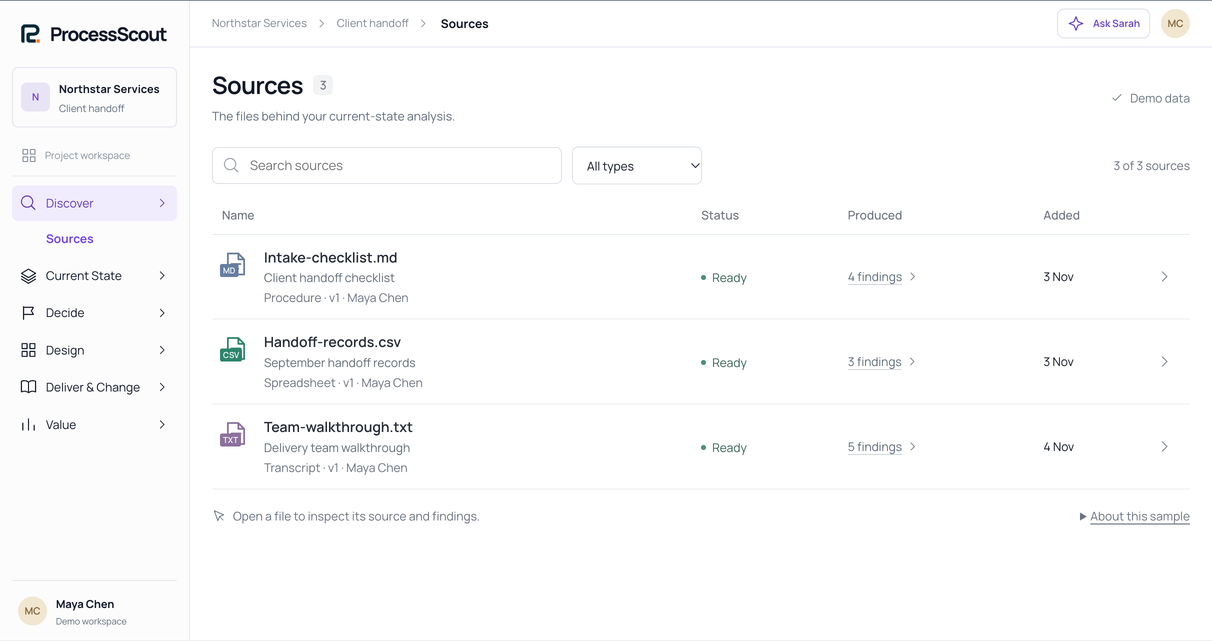
Inspect source evidence, conflicting rules and authored customer decisions together.

Follow fictional Northstar Supply through discovery, product decisions, requirements and handover. Every source, decision and requirement is open to inspect.
Fictional customer data. Open the evidence. No sign-up.
Inspect source evidence, conflicting rules and authored customer decisions together.
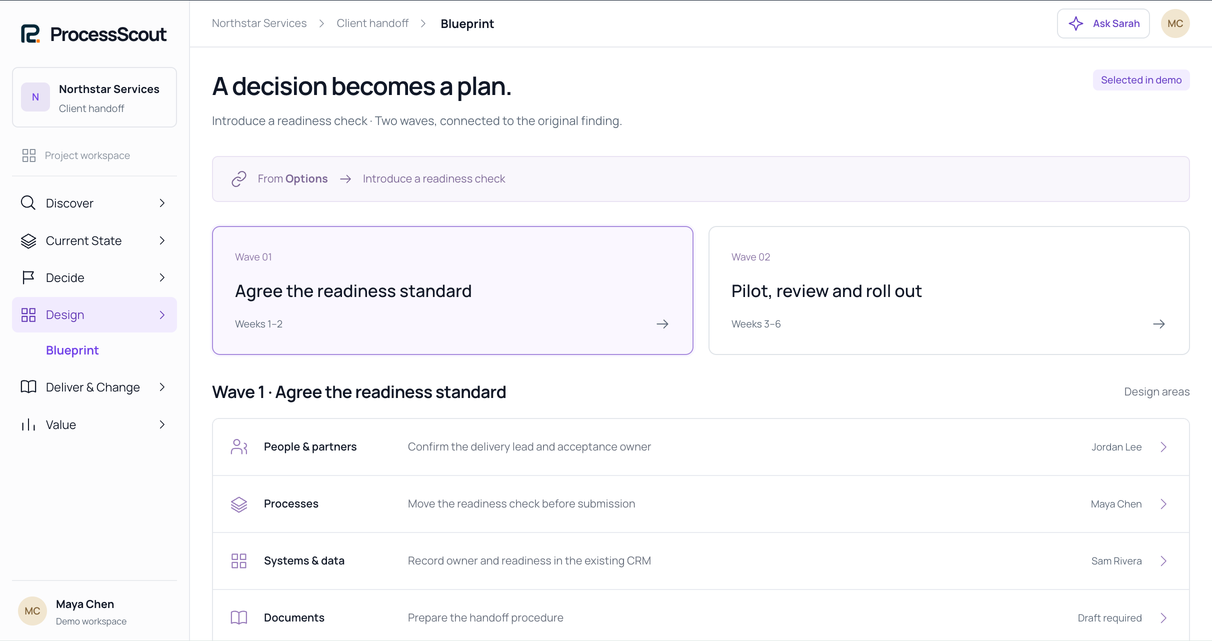
See included work, open questions and the pending change request.
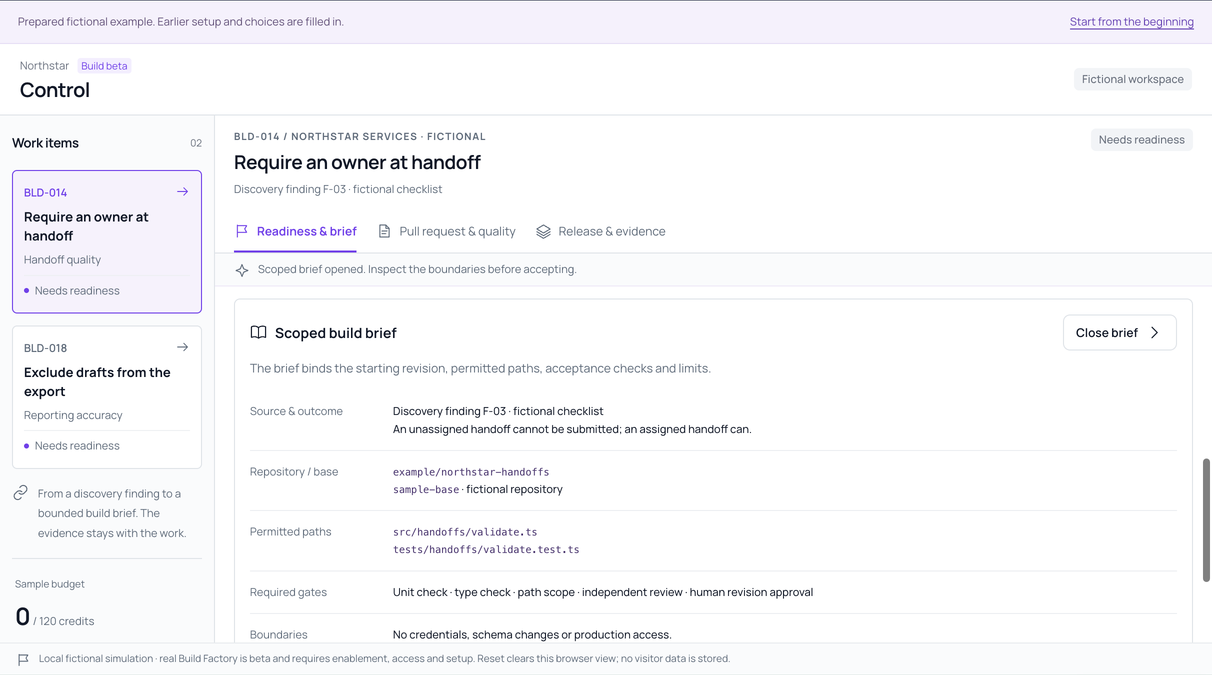
Connect requirements, acceptance cases, operating instructions and the measurement plan.
Northstar Supply · The worked example
A fictional purchase-approval deployment. Follow a disputed threshold from source evidence to a reviewed target, delivery requirements and operating ownership.
No live AI or changes to product records. Identity access and escalation ownership remain open.
Original sources POL-01 and WB-01 lead to authored decision D-01, requirement R-01, and operating instruction O-02. The customer decision is distinct from the supplied sources.
The customer is adopting a software vendor’s platform. Its delivery team proposes request intake, approval routing and an assistant that prepares recommendations. These are design choices for product and customer review, not completed configuration or a live agent.
Purchase requests, approval rules and urgent exceptions
Procedure · operating owner · escalation route
Inspect the handoverProposed use of a vendor’s product, subject to capability and implementation review. Access and escalation remain open.
Workflow is one part of the customer context. Review the people, handoffs, existing technology, data movement and controls as well. Unknowns remain visible rather than being filled in as facts.
Requester, purchasing manager and finance roles
POL-01REC-01Reporting lines and named owners to confirmPurchasing-manager notification and proposed approval routing
REC-01Escalation remains open under Q-05The approval workbook is supplied
WB-01ERP, messaging and identity systems to confirmThis register distinguishes supplied evidence from what still needs discovery. It is not a completed organization, architecture or data-flow model.
CR-01 asks to extend the brief into production integration. The vendor must decide whether this is configuration, a customer-specific extension or a broader product change before committing development effort.
Fit, gaps, requirements and roadmap decisions.
Explore Product ManagementPeople, systems, agents and operating responsibilities.
Inspect the target designYour engineering workflow or Build Factory Beta
Explore the build demoOperating handover and observed customer needs.
Feed learning into ProductCustomer learning informs the next product decision.
CR-01 is unapproved. No build or deployment has run. Build Factory requires configured runners, repository access and review.
The request extends the agreed brief. Production integration remains excluded until scope, architecture, access and effort are reviewed.
These prepared excerpts are the evidence for the fictional scenario. They are not presented as a verified product capture.
Prepared policy excerpt · version 1.0
Purchase orders above USD 10,000 require finance approval. All other purchase orders require purchasing-manager approval.
This original policy excerpt does not define an urgent-order exception. Its wording remains unchanged after the example review.
Prepared workbook fixture · version 1.0
northstar_purchase_approvals.xlsx
=IF(B2>=10000,"Finance review","Purchasing manager review")This formula refers to B2 in the same workbook version. Open the complete WB-01 excerpt.
The formula, input and illustrative saved result belong to the same fixture version. This website does not edit the workbook or recalculate an Excel file.
Authored transcript excerpt
For an urgent request, I mark it urgent and message the purchasing manager. I am not sure whether finance must approve it before release when the amount is high.
Authored for this fictional example. No recording or timestamp is implied. The speaker’s uncertainty does not establish permission to bypass approval.
A prepared comparison of the supplied rules, before customer review.
> 10000>= 10000The two supplied rules select the same route for this amount.
> 10000>= 10000Different routes. Q-01 requires a customer decision.
> 10000>= 10000The two supplied rules select the same route for this amount.
Changing this example amount compares the two rules. It does not edit WB-01; its saved B2 remains 10000.
The walkthrough describes marking an urgent request and messaging the purchasing manager. It does not confirm the authority to release a high-value order.
Request marked urgent → purchasing manager notified → finance approval before release is unclear.
Read the authored walkthroughProposed target after D-01 and D-02. The original walkthrough remains uncertain about finance approval.
Q-05 · Who receives an escalation, and through which route?
Owner: Customer process owner
“Finance reviews orders above USD 10,000; an urgent request messages the purchasing manager.”
POL-01REC-01This draft does not settle the boundary or permission to release an urgent order.
“Use finance review at or above USD 10,000. Urgent requests still need the required approval; notifying the purchasing manager is an additional step.”
Customer process owner · fictional review
D-01 · threshold · D-02 · urgencyThis prepared review changes the proposed target behavior. The policy and walkthrough remain unchanged as supplied evidence.
Q-01–Q-03 have authored resolutions in this example. Q-04 and Q-05 remain open prerequisites for live operation.
The policy says above; the workbook says at or above. A customer decision is needed to define the target rule.
Owner: Customer process owner
POL-01WB-01The walkthrough identifies a purchasing-manager notification but leaves approval before release uncertain. The policy supplies no urgent exception.
Owner: Customer process owner
REC-01POL-01A valid amount is necessary to apply the target rule. Missing-amount behavior is a proposed design decision, not an observation from the supplied sources.
Owner: Customer process owner
WB-01Confirm the identity source, reviewer membership, permissions and access with the technical delivery lead. This prerequisite remains unresolved.
Owner: Customer process owner
Escalation route: To be agreed. The owner of this decision is not assumed to be the eventual escalation recipient.
Owner: Customer process owner
A human decision defines the proposed target. Original evidence stays available, including the disagreement at exactly USD 10,000.
“Finance reviews orders above USD 10,000; an urgent request messages the purchasing manager.”
POL-01REC-01This draft does not settle the boundary or permission to release an urgent order.
“Use finance review at or above USD 10,000. Urgent requests still need the required approval; notifying the purchasing manager is an additional step.”
Customer process owner · fictional review
D-01 · threshold · D-02 · urgencyThis prepared review changes the proposed target behavior. The policy and walkthrough remain unchanged as supplied evidence.
For the proposed target workflow, purchase orders at or above USD 10,000 require finance approval. Lower amounts require purchasing-manager approval.
Authored customer review decision. POL-01 retains its original “above” wording; the target follows the inclusive boundary visible in WB-01.
Reviewer: Customer process owner · fictional role
An urgent request notifies the purchasing manager, while the amount still determines the required approval route. Urgency does not authorize release or bypass approval.
Authored customer review decision for the target workflow. REC-01 leaves this behavior uncertain; it is not inferred as current practice.
Reviewer: Customer process owner · fictional role
When the purchase amount is missing, request clarification from the requester. Do not prepare an approval recommendation until a valid amount is supplied.
Authored customer review decision for the target workflow. The source fixture does not establish missing-amount behavior.
Reviewer: Customer process owner · fictional role
Select a requirement to inspect its source, decision reference and expected behavior. These business requirements still need technical discovery and implementation checks.
At or above USD 10,000 → Finance review. Below USD 10,000 → Purchasing manager review.
Purchasing manager review
R-01 · Expected behaviorFinance review
R-01 · Expected behaviorFinance review
R-01 · Expected behaviorThese are expected behaviors for the fictional target. No model or implementation tests have been executed.
Implementation and access checks remain with the delivery team; see Q-04 and Q-05.
Notify the purchasing manager when a request is urgent. Apply R-01 to choose the required approver; urgency does not bypass approval or authorize release.
Notify purchasing manager; finance approval still required. No bypass or release.
Implementation and access checks remain with the delivery team; see Q-04 and Q-05.
If the amount is missing, request clarification. Do not prepare an approval recommendation until a valid amount is supplied.
Request clarification; do not prepare an approval recommendation.
Implementation and access checks remain with the delivery team; see Q-04 and Q-05.
The rows below are acceptance examples for the fictional target, not evidence that an implementation or model has passed a test.
Purchasing manager review
R-01 · Expected behaviorFinance review
R-01 · Expected behaviorFinance review
R-01 · Expected behaviorNotify purchasing manager; finance approval still required. No bypass or release.
R-02 · Expected behaviorRequest clarification; do not prepare an approval recommendation.
R-03 · Expected behaviorThese are expected behaviors for the fictional target. No model or implementation tests have been executed.
The example prepares a purchase-routing brief. Commercial estimates and delivery commitments remain the strategist’s responsibility.
Q-04 · Which identities and access rights will support the workflow?
Owner: Customer process owner
Prepared instructions for customer review. The original policy still says “above”; D-01 deliberately defines a different target boundary.
Decision owner: Customer process owner. Q-04 · identity and access also remains open. Live operation is not ready on the strength of this brief alone.
Every role below is fictional. A prepared brief does not establish production readiness.
Prepare the brief, preserve source references and carry open questions into implementation.
Confirm business behavior and acceptance; resolve Q-04 and Q-05 with the relevant specialists.
Confirm architecture, identity/access and implementation checks. Run implementation tests before a readiness decision.
Maintain the procedure and follow the agreed approval route after operational readiness is established.
Fictional role labels. Reviewed rule: R-01 · at or above USD 10,000 goes to finance.
Q-04 · Which identities and access rights will support the workflow?
Owner: Customer process owner
Customer operating results and engineering effort are separate measures. Neither has an observed result in this example.
Measurement owner: Customer process owner
Define the business-hours calendar, event data source and measurement window before collecting a baseline.
Review cadence and measurement window: To agree
Business-hours calendar, data source and measurement window: To agree.
Measurement owner: Vendor delivery lead
Record total staff effort through review for a comparable workflow. Keep this vendor-effort measure separate from the customer’s operating outcome.
Review period: To agree during pilot scoping
This is a design input for the vendor’s AI implementation. The website does not operate an agent, enforce permissions or execute an evaluation.
Order ID · valid amount in USD · urgent status · reviewed routing rule
Proposed design for the customer implementation. Urgency never authorizes bypass. Identity and access (Q-04) and escalation (Q-05) remain open.
Notify the purchasing manager. The amount-based approval still applies; urgency cannot authorize bypass or release.
Inspect urgent-request behaviorAsk the requester for clarification. Do not prepare an approval recommendation until a valid amount is supplied.
Inspect incomplete-request behaviorKeep the disagreement visible and ask the customer process owner to decide. A proposed assistant must not invent a resolution.
Inspect the question registerResolve Q-04 and Q-05, then execute model evaluation, integration tests and operational checks against the agreed requirements. Record actual results separately from these expected behaviors.
One inspectable chain connects supplied evidence, a question, a fictional human decision, a requirement and an operating instruction.
“Above” and “at or above” disagree at USD 10,000.
Which route should the target use at the boundary?
The fictional customer owner chooses the inclusive threshold.
At or above USD 10,000 → finance review.
Prepare the route; a person records the approval decision.
End of the complete authored sample brief. Illustrative example - fictional customer data. The example records no customer outcome or completed deployment.
Discuss the source material, useful deliverables and measures for a focused evaluation.
Discuss a pilotBring one workflow to scope your deployment brief.
Discuss a pilotScope, timing, access and terms are agreed before a pilot begins.
Allow optional analytics to help us improve ProcessScout? Privacy notice